Messier 101 (M101)
Common Name: Pinwheel Galaxy
Also Known as: NGC 5457, Arp 26
Object Type: Spiral Galaxy
Constellation: Ursa Major
Distance from Earth: 20.9 million light years
Apparent Magnitude: 7.86
Coordinates: RA 14H 03M 12.6S DEC 54 deg 20 min 57 sec
Actual Size: 170,000 light years in diameter
Apparent Dimensions: 28.8 arc-minutes x 26.9 arc-minutes
Discovered by: M 101 was discovered by the French astronomer Pierre Méchain on March 27, 1781.
Méchain reported the discovery to his colleague Charles Messier, who verified the object’s position and added it to his catalogue with the following note: Nebula without star, very obscure & pretty large, of 6 or 7 minutes [of arc] in diameter, between the left hand of Boötes & the tail of the great Bear.
Description: M101 is a face-on spiral galaxy and is estimated to contain 1 trillion stars.
Young and old stars seem to be evenly distributed along the galaxy’s spiral arms.
With a linear extension of 170,000 light years, the Pinwheel Galaxy is about 70 percent larger than the Milky Way.
The estimated mass of M101’s disk is about 100 billion solar masses, while its small central bulge has a mass 3 billion times that of the Sun.
The galaxy has an absolute magnitude of -21.6, corresponding to a luminosity of 30 billion Suns.
The galaxy does not appear to have a supermassive black hole at its center, as observations in radio and X-ray wavelengths have not detected a strong source of emissions in the galactic core.
The Pinwheel Galaxy appears symmetric in images that only reveal its central region, but is really quite asymmetrical as a result of interactions with smaller companion galaxies. The galaxy’s core is displaced from the center, likely as a result of a collision in the recent past.
M101 has five prominent companions: NGC 5204, NGC 5474, NGC 5477, NGC 5585 and Holmberg IV. Gravitational interaction with these galaxies is suspected to have triggered the formation of the grand design structure in M101 and distorted NGC 5474.
While the Pinwheel Galaxy appears to be symmetrical, it is actually quite asymmetrical due to interactions with smaller companion galaxies.
The Pinwheel Galaxy and its companions form the M101 Group, a group of at least nine galaxies centered on M101.
In addition to the Pinwheel’s companions, probable group members include the galaxies NGC 5238, UGC 8508 and UGC 9405.
Click Below Image(s) for Full Size:
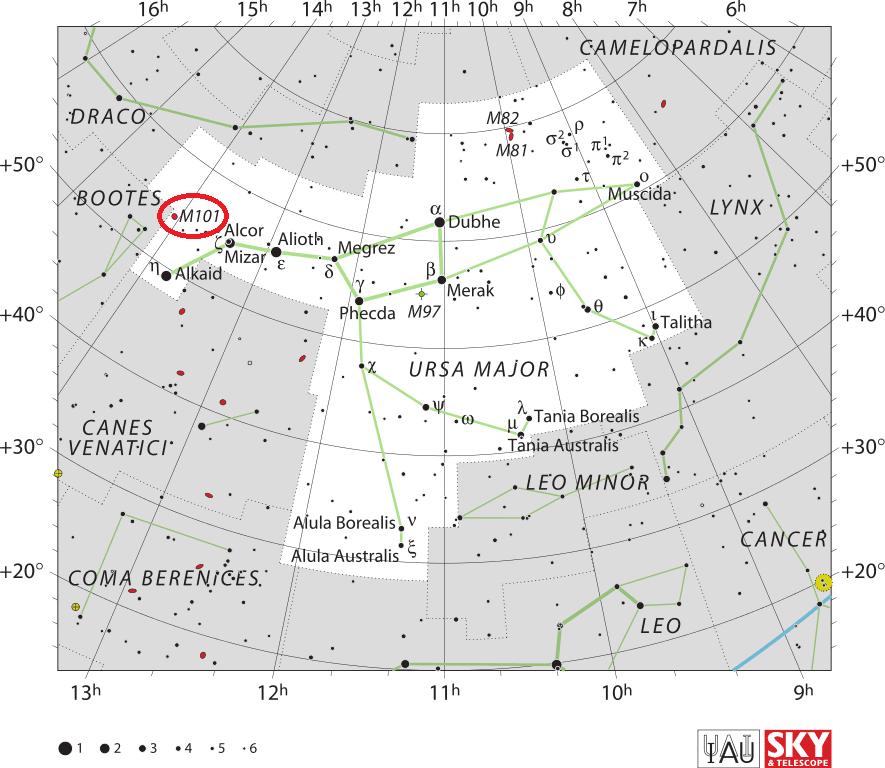
M101 is easy to find since it is just above the handle of the Big Dipper.
M101 can be spotted using 10x50 binoculars under good conditions, but would only appear as a large, faint patch of light.
A 4-inch telescope reveals the galaxy’s brighter central region and spiral structure. 8-inch scopes would reveal the galaxy’s dense core surrounded by a faint halo dotted with patches of nebulosity and hinting at the spiral structure.
The best time of year to observe the Pinwheel Galaxy is during the spring.
Platesolve
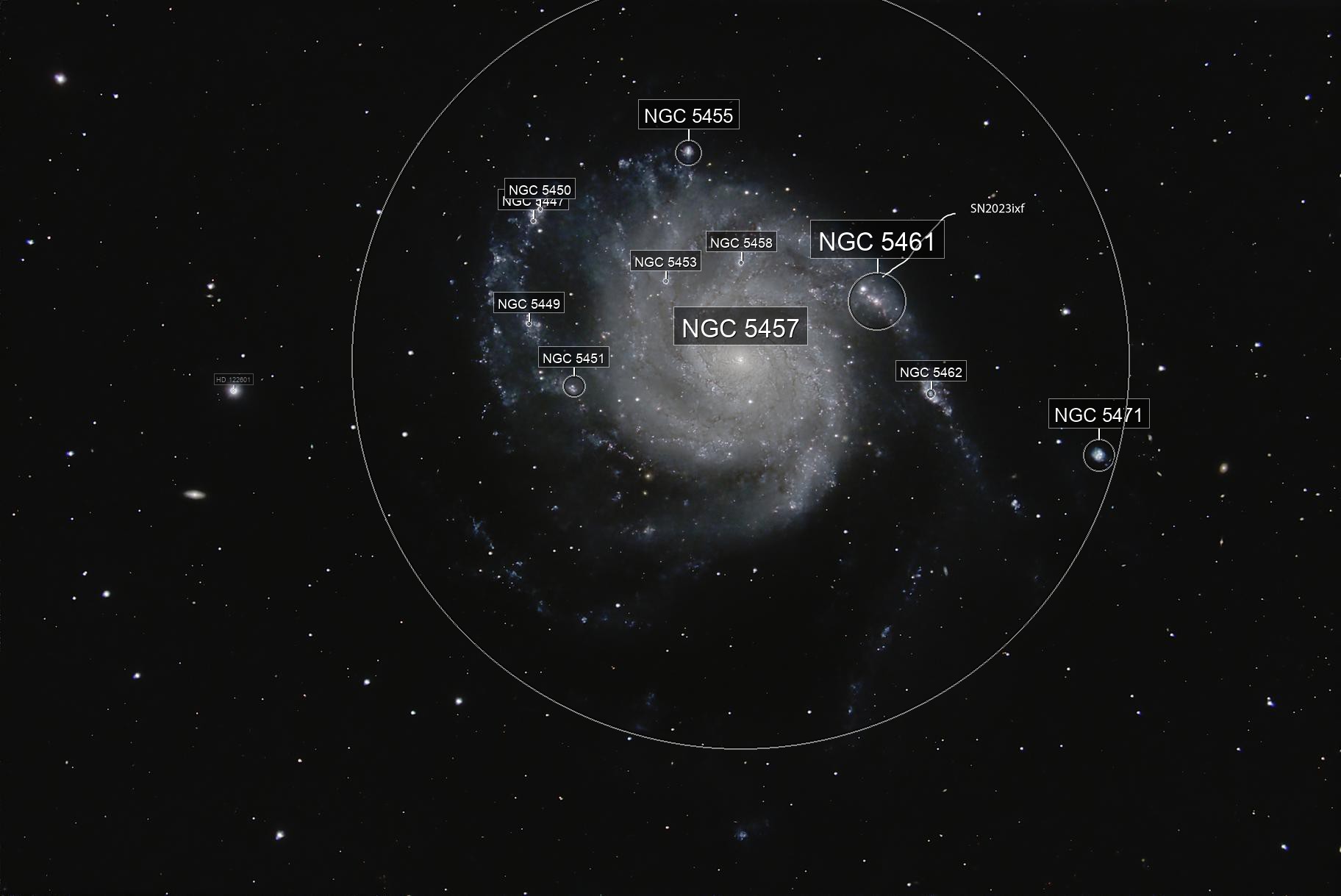
M101 Pinwheel Galaxy

Imaging Details
Click to Return to Home Page