Messier 11 (M11)
Common Name: Wild Duck
Also Known as: NGC 6705, Collinder 391, Mel 213
Object Type: Open Cluster
Constellation: Scutum
Distance from Earth: 6,120 light years
Apparent Magnitude: 6.3
Coordinates: RA 18H 51M 05S DEC -06 deg 16 min 12 sec
Actual Size: 14’ core - 4 light years radius with tidal radius - 95 light years
Apparent Dimensions: 22.8 arc minutes.
Discovered by: M11 was discovered Gottfried Kirch in 1681. English astronomer William Derham was the first to resolve the cluster into stars around 1733.
Charles Messier added the cluster to his catalogue on May 30, 1764.
Description: The Wild Duck Cluster is the most distant open cluster listed in the Messier catalogue that is visible to the naked eye.
The cluster contains about 2,900 stars, which makes it one of the most populated open clusters known. It is also one of the most compact clusters and appears as a diamond-shaped patch in binoculars.
The brighter members of the cluster form a V-shaped triangle that could be said to resemble a flock of ducks when observed in a small telescope, which is how M11 got its name.
Its popular name derives from the brighter stars forming a triangle which could resemble a flying flock of ducks (or, from other angles, one swimming duck).
The stars in the cluster are only loosely bound to one another and M11 will disperse in a few million years, as its members are ejected one by one as a result of the cluster being affected by gravity from other celestial objects in the vicinity.
The cluster is located just to the east of the Scutum Star Cloud midpoint. The Wild Duck Cluster is one of the richest and most compact of the known open clusters.
It is one of the most massive open clusters known, and it has been extensively studied. Its age has been estimated to about 220 million years.
The brightest cluster member is visual magnitude 8, and it has 500 members of at least magnitude 14.
Click Below Image(s) for Full Size:
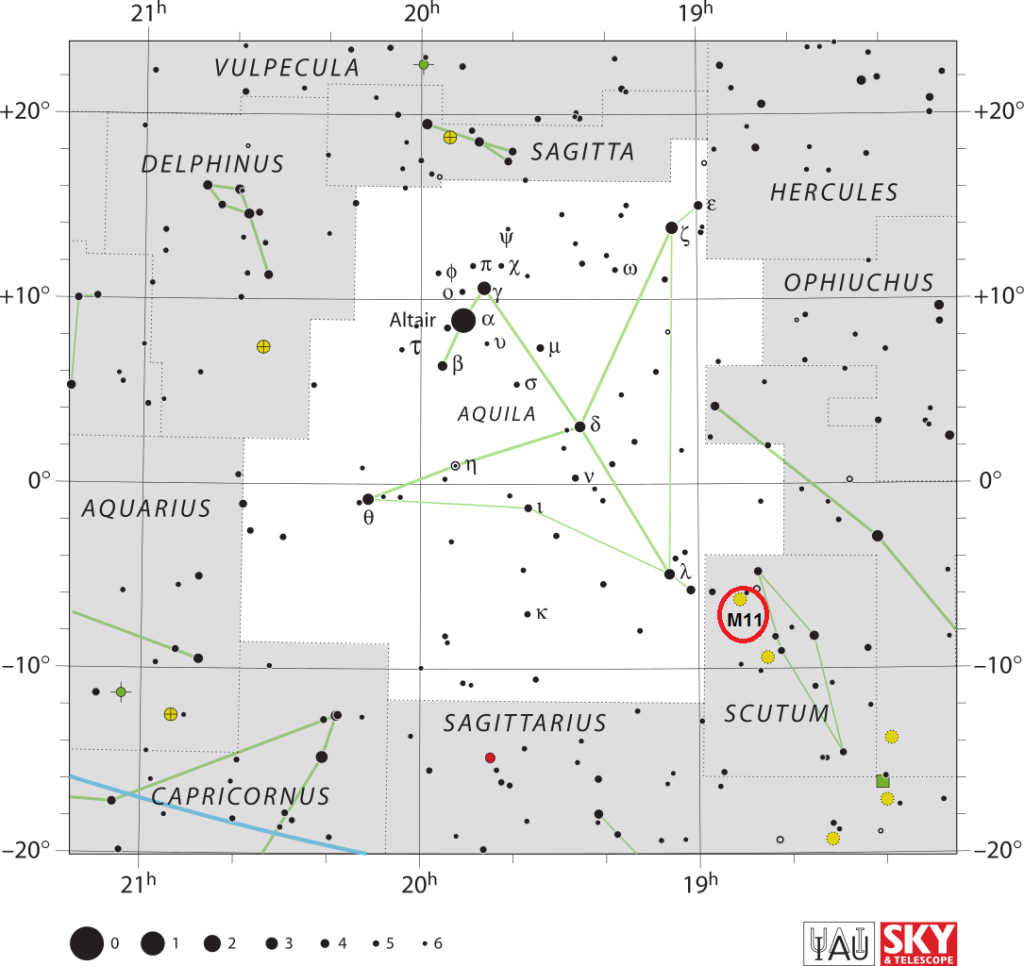
Messier 11 can be seen without binoculars and appears as a faint patch of light above the southern horizon for observers in the northern hemisphere.
The best time of year to observe the cluster is from June to September, when it rises high in the night sky.
Platesolve
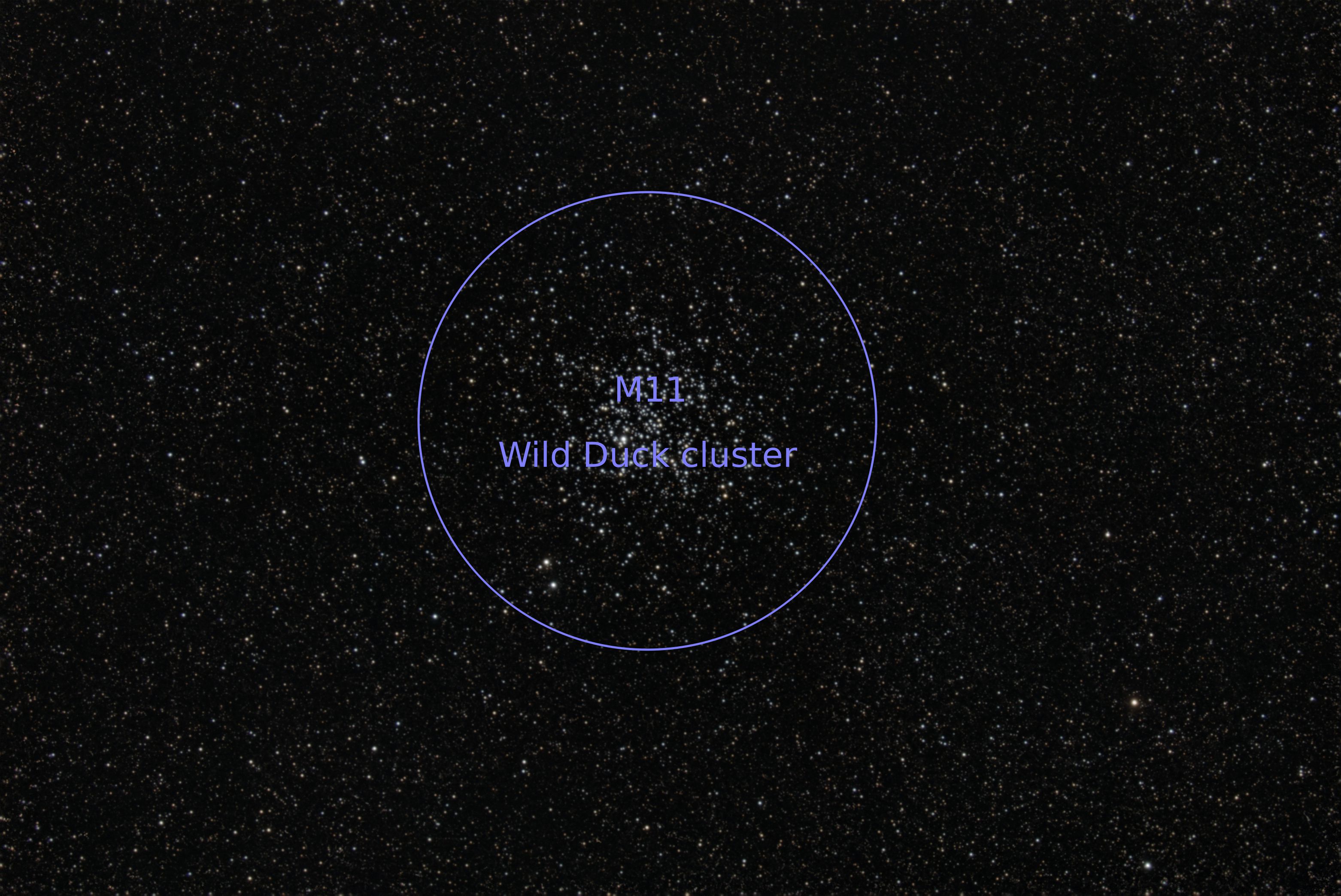
M11 Open Cluster

Imaging Details
Click to Return to Home Page