Messier 14 (M14)
Also Known as: NGC 6402, BD-03 4142
Object Type: Globular Cluster
Constellation: Ophiuchus
Distance from Earth: 30,300 Light years
Apparent Magnitude: 7.6
Coordinates: RA 17H 37M 36.15S DEC -3 deg 14 min 45.3 sec
Actual Size: 100 light years in diameter.
Apparent Dimensions: 11 arc minutes.
Discovered by: Charles Messier 1764 who described it as a nebula without stars. William Herschel was the first to resolve stars in M14 in 1783.
Description: Messier 14 is elongated in shape and contains about 150,000 stars. It occupies an area about 100 light years across in size.
The total luminosity of M14 is approximately 400,000 times that of or Sun.
The shape of the globular is elongated extending almost 100 light years across.
Messier 14 is a class VIII globular cluster, which means that its stars are not particularly densely concentrated in the central region.
The cluster’s bright main portion spans only 3 arc minutes in angular diameter, but the outermost regions give M14 a total angular diameter of 11.7 arc minutes.
There are 70 variable stars known in M14.
A nova occurred in M14 in 1938 and reached a visual magnitude of +9.2, but was not discovered until 1964, when astronomers surveyed a series of photographic plates from that period.
Messier 14 has an absolute magnitude of -9.12 and a total luminosity about 400,000 times that of the Sun.
While it appears fainter than Messier 10 and Messier 12, the other two famous globular clusters in Ophiuchus, M14 is the largest of the three and has a significantly greater intrinsic luminosity than the other two.
It is almost twice as distant as M12 and more than twice as distant as M10.
Messier 14 is located 0.8 degrees north and 10 degrees east of Messier 10 and about 21 degrees east and 0.4 degrees north of the star Delta Ophiuchi.
It can be found about one-third of the way from Beta to Eta Ophiuchi.
Click Below Image(s) for Full Size:
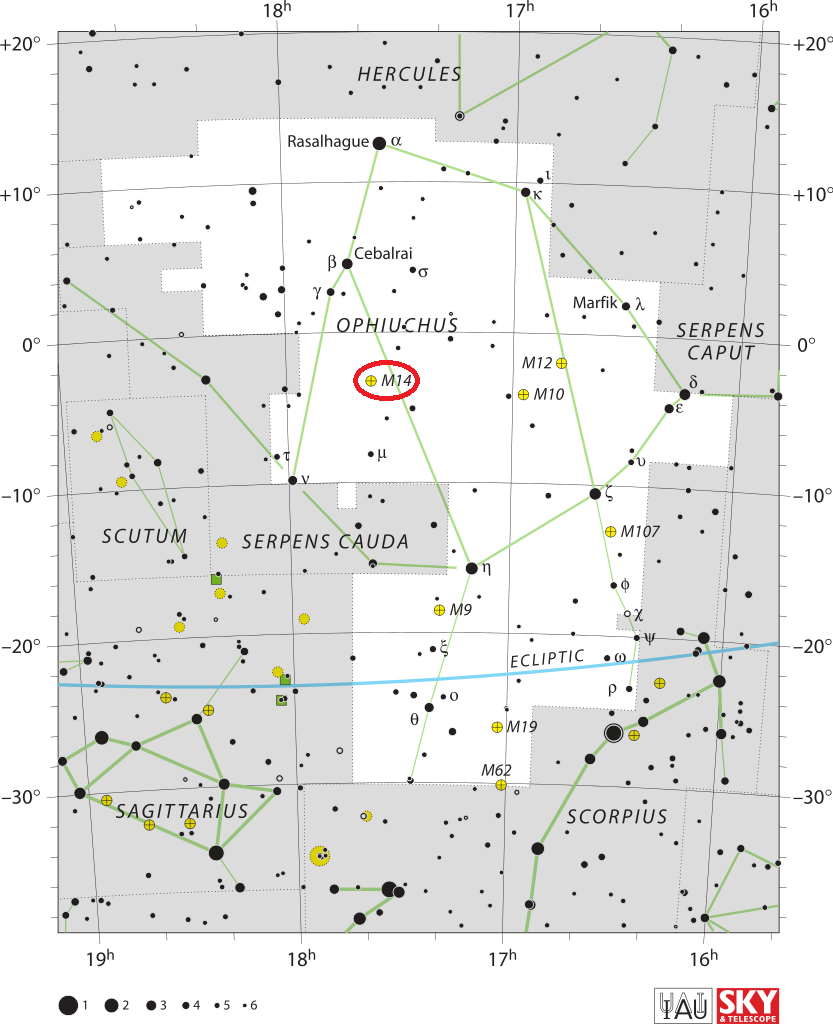
While M14 is not visible to the naked eye, it can easily be seen with binoculars.
The bright center and faint outer halo of M14 appear in small telescopes, while 8-inch instruments will reveal the cluster’s elliptical shape.
Individual stars in the cluster can only be resolved in 12-inch and larger telescopes.
The best time to view M14 is May-July.
Platesolve
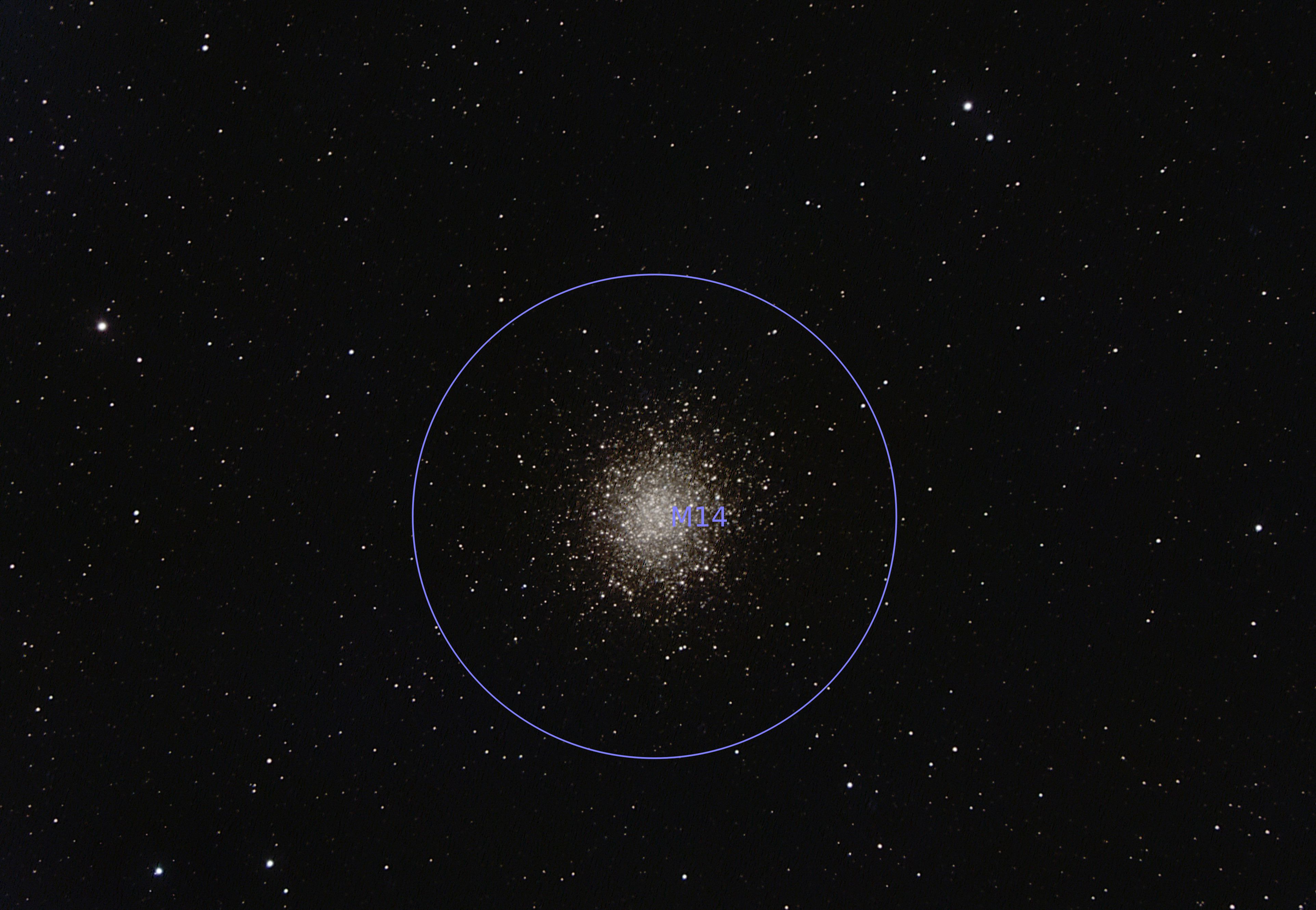
M14 Globular Cluster

Imaging Details
Click to Return to Home Page