Messier 26 (M26)
Also Known as: NGC 6694, Collinder 389
Object Type: Open Cluster
Constellation: Scutum
Distance from Earth: 5,160 light years
Apparent Magnitude: 8.0
Coordinates: RA 18H 45M 18S DEC -09 deg 23 min 00 sec
Actual Size: 22 light years across with a tidal radius 25 light years
Apparent Dimensions: 15 arc minutes.
Discovered by: Charles Messier discovered the cluster on June 20, 1764. He described it as a “cluster near Eta and Omicron in Antinous [now Alpha and Delta Scuti], between which there is another one of more brightness: with a telescope of 3.5-foot [FL] one cannot distinguish them, one needs to employ a good instrument. This cluster contains no nebulosity.”
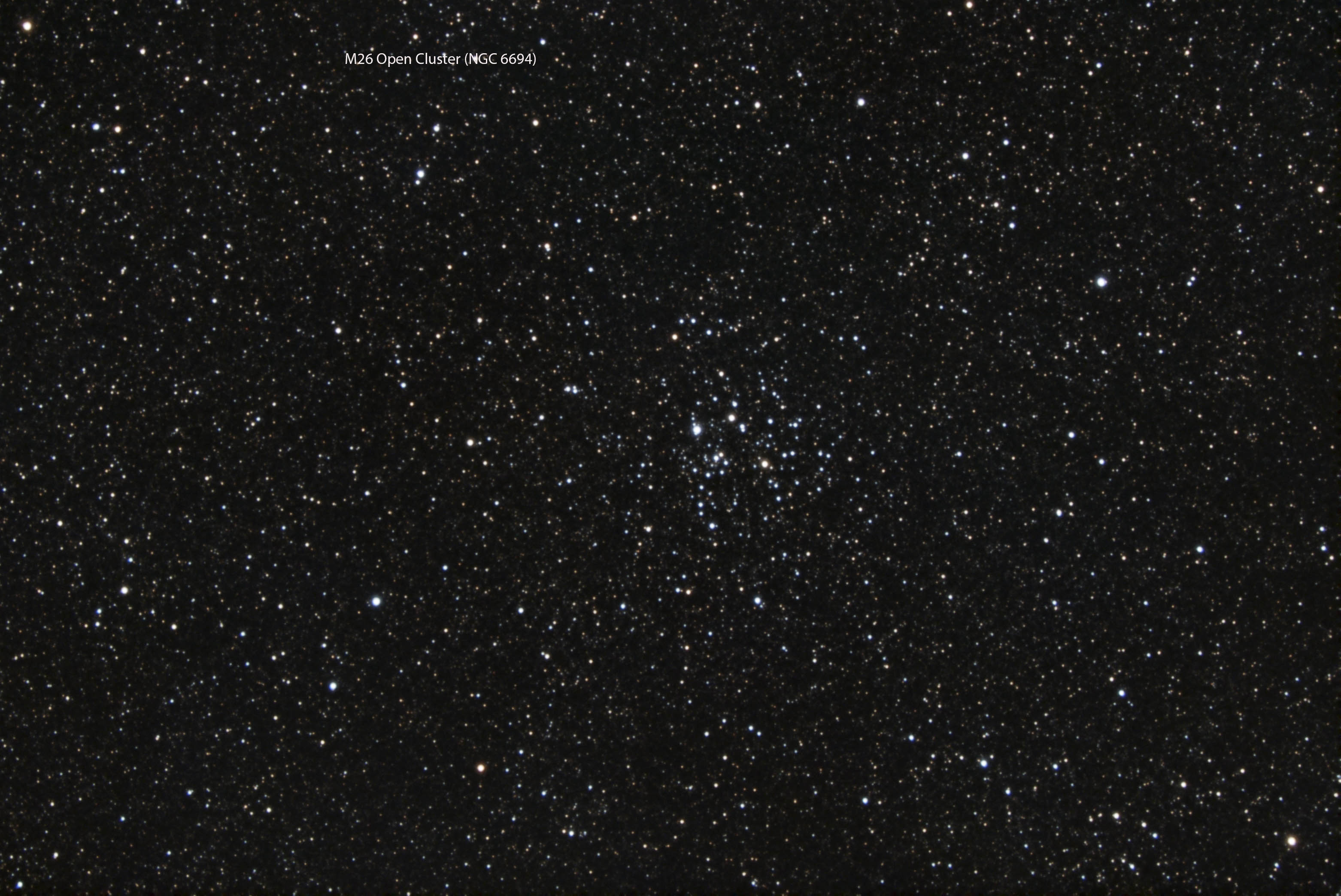
Description: Messier 26 is an open cluster in the constellation of Scutum.
Messier 26 is notable for a region of low star density near the cluster’s center, likely a result of a cloud of interstellar dust blocking the light of the stars from our view.
The low density zone is 3.1 arc minutes in diameter and located at the center of the cluster.
A hypothesis was that it was caused by an obscuring cloud of interstellar matter between us and the cluster, but a paper by James Cuffey suggested that this is not possible and that it really is a "shell of low stellar space density".
Click Below Image(s) for Full Size:

Small telescopes will reveal a compact star cluster, and 6-inch and 8-inch telescopes will resolve about 25 brightest stars.
The cluster contains a total of about 90 members.
The best time of year to observe it is from June to September.
Platesolve

M26 Open Cluster
Imaging Details
Click to Return to Home Page