Messier 2 (M2)
Also Known as: NGC 7089, GC 4678, Bode 70
Object Type: Globular Cluster
Constellation: Aquarius
Distance from Earth: 37,500 Light years
Apparent Magnitude: 6.3
Coordinates: RA 21H 33M 27.02S DEC -00 deg 49 min 23.7 sec
Actual Size: 175 light years in diameter. Dense central region is 0.34 arc minutes across (3.7 light years).
Apparent Dimensions: 16 arc minutes.
Discovered by: M2 was discovered by the Italian-born French astronomer Jean-Dominique Maraldi on September 11, 1746.
Maraldi discovered the object while observing a comet with the French astronomer Jacques Cassini, the son of the famous Italian astronomer Giovanni Cassini.
Charles Messier rediscovered it in 1760 but thought that it was a nebula without any stars.
William Herschel resolved individual stars in 1783. It is the first globular cluster to be included in Messier’s catalogue.
Description: M2 is one of the larger known globular clusters.
At 13 billion years old, it is one of the oldest globular clusters associated with the Milky way.
The Universe is estimated to be 13.8 billion years old, which means that the cluster likely formed when the Universe was only 6 percent of its current age, less than a billion years old.
The cluster orbits in the halo of the Milky Way and contains some of our galaxy’s oldest known stars.
As the stars are much older than the Sun, they have few elements heavier than hydrogen and helium, which makes the existence of Earth-like planets highly unlikely in the cluster.
M2 is moving toward us at about 5.3 kilometers per second.
It contains about 150,000 stars. The brightest stars are red and yellow giant stars.
It is rich, compact and significantly elliptical.
Click Below Image(s) for Full Size:
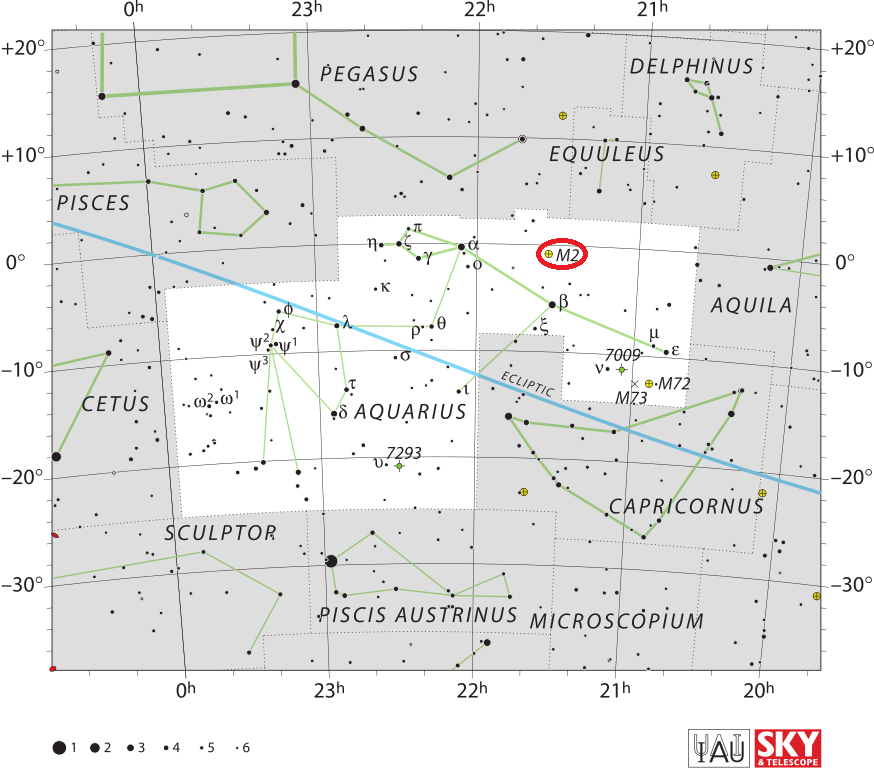
With an apparent magnitude of 6.3, Messier 2 is just at the edge of naked eye visibility, but requires extremely good viewing conditions, with clear skies and no light pollution.
The globular cluster can be observed in binoculars and small telescopes, but individual stars can only be seen in larger instruments, starting with 6-inch telescopes.
A peculiar dark lane can be seen crossing the northeast edge of the cluster in larger telescopes.
Larger instruments are required to resolve the stars because the cluster is very far away and the stars in it are old, so only the rare stars similar to the Sun and the occasional blue straggler are visible.
Blue stragglers are main sequence stars found in clusters, that appear bluer and more luminous than stars at the main sequence turn-off point for the cluster.
The best time of year to observe the cluster is between the months of July and October.
Platesolve
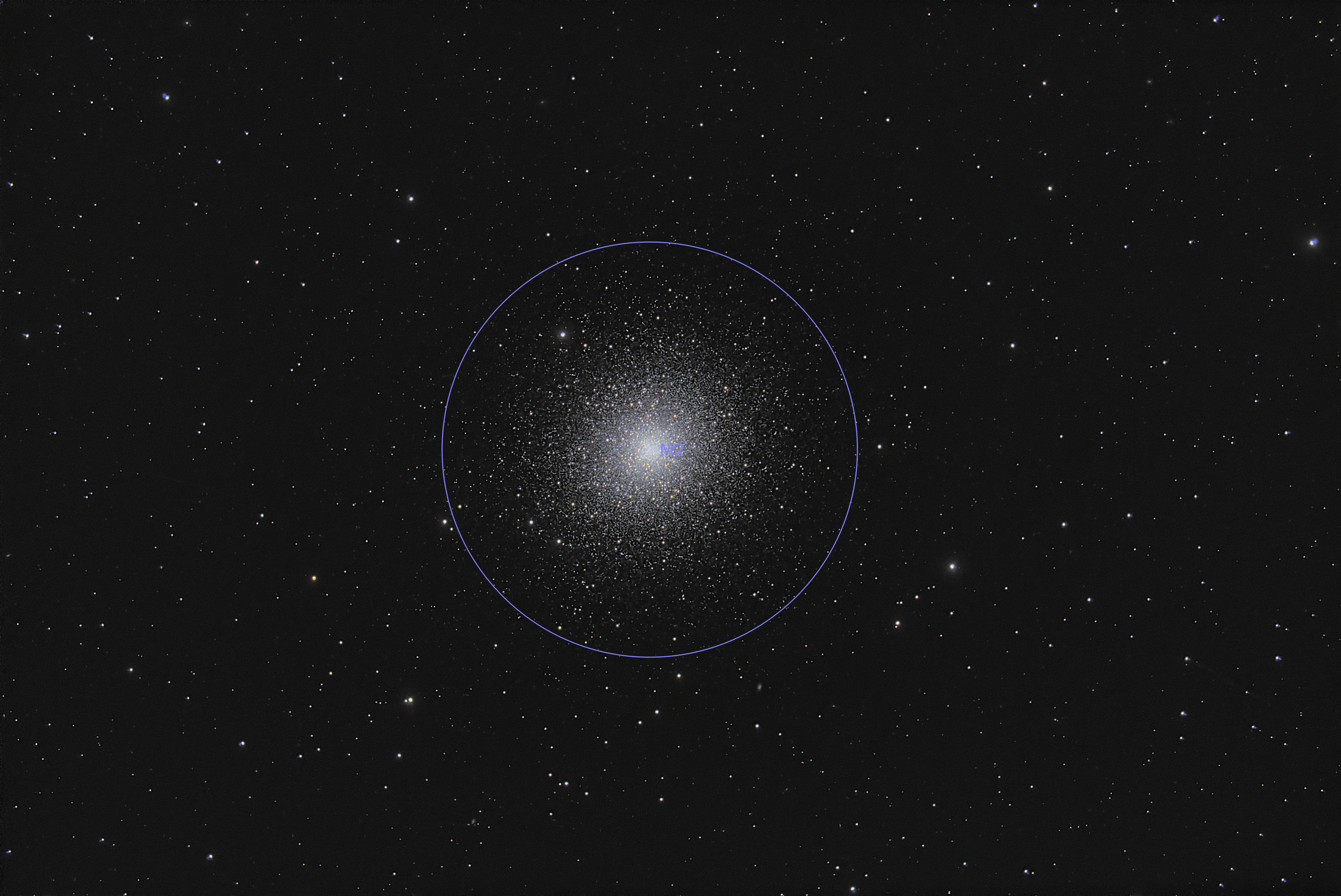
M2 Globular Cluster

Imaging Details
Click to Return to Home Page