Messier 3 (M3)
Also Known as: NGC 5272
Object Type: Globular Cluster
Constellation: Canes Venatici
Distance from Earth: 33,900 Light years
Apparent Magnitude: 6.2
Coordinates: RA 13H 42M 11.62S DEC 28 deg 22 min 38.2 sec
Actual Size: 180 light years in diameter. The dense core measures 1.1 arc minutes (11 light years).
Apparent Dimensions: 18 arc minutes.
Discovered by: The cluster was discovered by Charles Messier on May 3, 1764.
It was the 75th deep sky object ever observed at the time of discovery and the first object in the Messier catalogue discovered by Messier himself.
In 1784 William Herschel was the first to resolve M3 into stars and recognize it as a cluster.
Description: M3 is one of the brightest and largest globular clusters.
Messier 3 is one of the most popular targets among amateur astronomers next to Messier 13, the Hercules Globular Cluster, and one of the most studied of all known globular clusters.
It has an absolute magnitude of about -8.93 and a luminosity about 300,000 times that of the Sun. The cluster is approaching us at 147.6 km/s.
M3 contains about 500,000 stars. Messier 3 is one of the 250 or so known globular clusters in the Milky Way Galaxy.
The cluster lies 38,900 light years or 11,900 parsecs from the galactic center and 31,600 light years or 9,700 parsecs above the plane of the Milky Way, in the galaxy’s halo.
When observed from Earth, the cluster lies in the direction of intergalactic space, opposite to the galactic center.
It is believed that M3 is between 8 and 11.4 billion years old and contains mostly old, red stars.
Click Below Image(s) for Full Size:
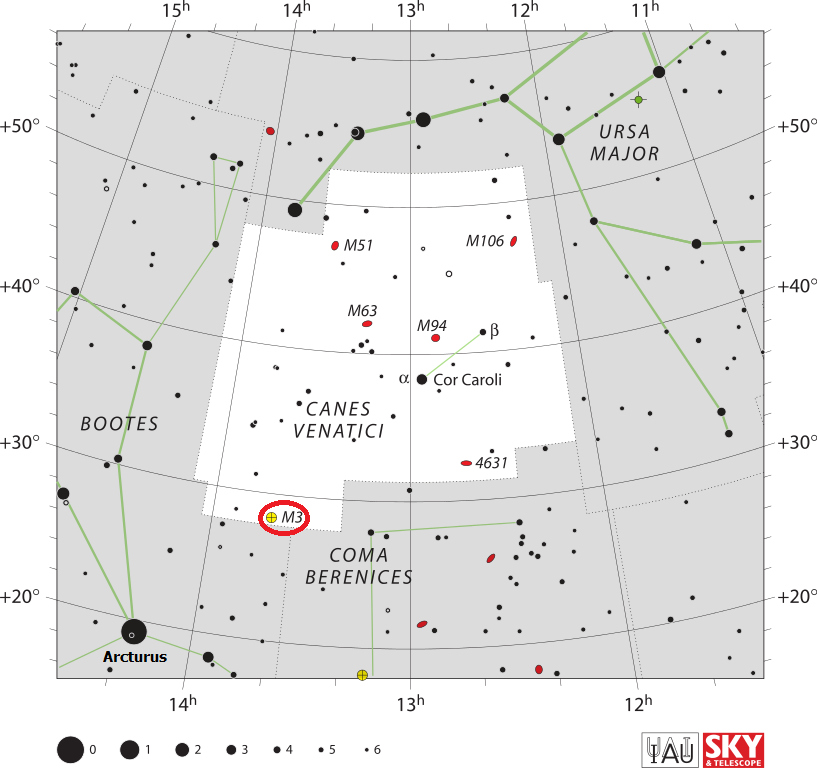
With a visual magnitude of 6.2, Messier 3 is difficult (but not impossible) to see without binoculars even in good viewing conditions, but the cluster appears fully defined in a moderate-sized telescope.
A 4-inch telescope will reveal the bright core without resolving individual stars.
A 6-inch instrument will resolve some of the outer stars, while an 8-inch telescope will reveal the stars everywhere in the cluster except in the bright core region.
The central region of M3 can only be resolved into stars by larger instruments, starting with telescopes with a 12-inch aperture.
The best time to view M3 is March-May.
Platesolve
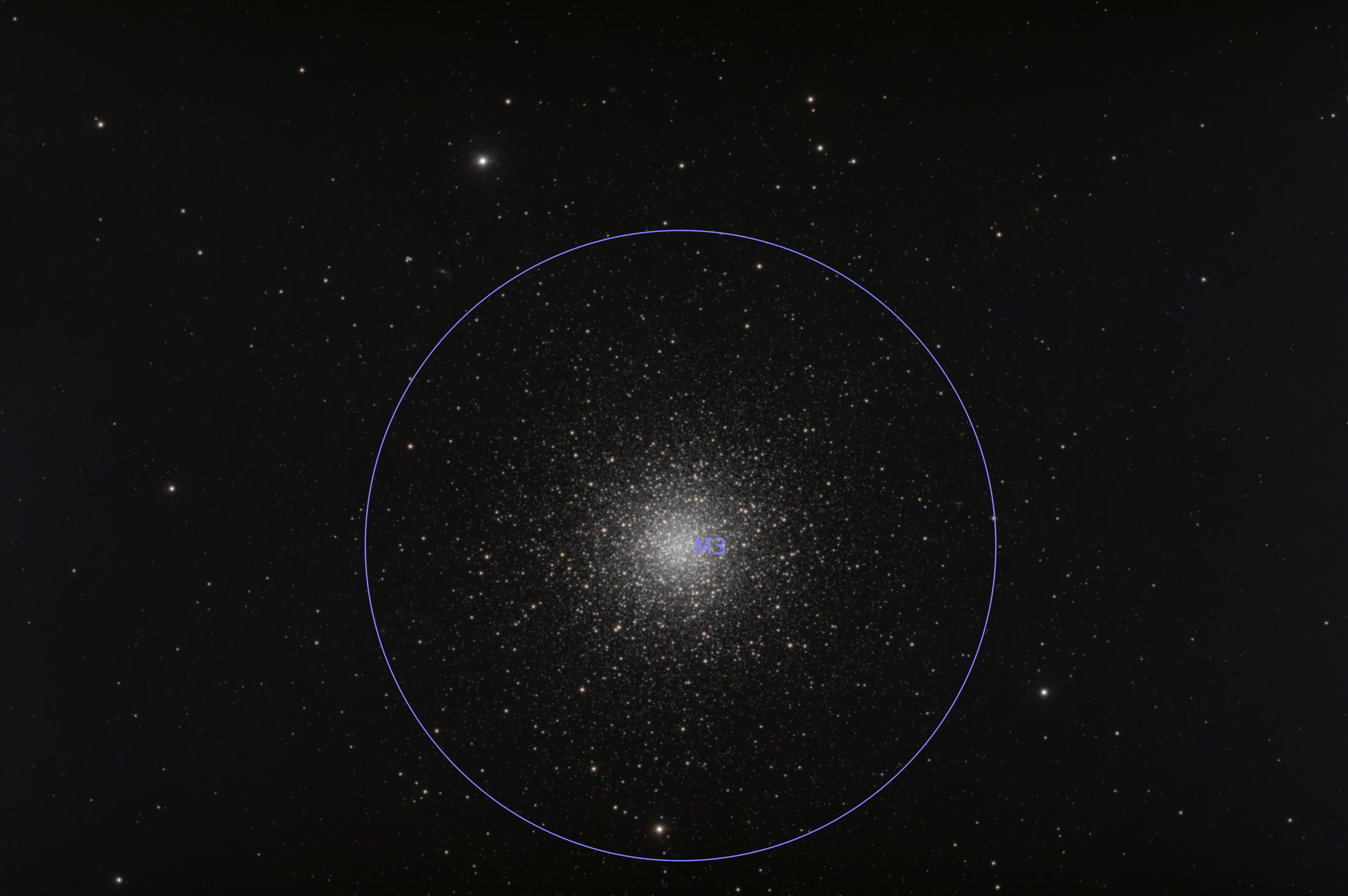
M3 Globular Cluster

Imaging Details
Click to Return to Home Page