Messier 45 (M45)
Common Name: Pleiades
Also Known as: Seven Sisters, Subaru, Collinder 62, Melotte 22
Object Type: Open Cluster
Constellation: Taurus
Distance from Earth: 444 light years
Apparent Magnitude: 1.6
Coordinates: RA 03H 47M 24S DEC 24 deg 07 min 0 sec
Actual Size: 17.5 light years in diameter
Apparent Dimensions: 110 arc-minutes
Discovered by: The earliest description of M45 was found on a bronze age artifact (Nebra disk) dating to 1,600 BCE.
It is also mentioned as Khima in the Bible. Persians knew the cluster as Soraya and Japanese knew it as Subaru. Galileo Galilei was the first astronomer to observe M45 through a telescope.
He published his notes with a sketch of the cluster in a short astronomical treatise titled Sidereus Nuncius (Sidereal Messenger) in March 1610.
His sketch showed 36 of the cluster’s stars.
Italian astronomer Giovanni Battista Hodierna counted 37 stars in the cluster in 1654, noting that “the first, and the most lumious of all assemblies of stars, shines in the belly of Taurus; six, or seven stars are most evident, before many others…”
Charles Messier catalogued the Pleiades as Messier 45 on March 4, 1769, describing the object simply as a “cluster of stars, known by the name of the Pleiades. The position reported is that of the star Alcyone.”
Description: M45 is a bright and large open cluster that does not have an NGC number.
Messier 45 contains a number of hot, blue, extremely luminous B-type stars and is one of the nearest star clusters to Earth.
The names of the nine brightest stars in M45 are taken from Greek mythology and they represent the Pleiades, the Seven Sisters – Asterope, Electra, Merope, Maia, Celaeno, Taygeta, and Alcyone – and their parents, Pleione and Atlas.
The stars in the Pleiades cluster have formed in the last 100 million years and they will stay gravitationally bound to each other for another 250 million years before the cluster disperses as a result of tidal interactions with other objects in the neighborhood.
By that point, the cluster will have moved from Taurus to Orion.
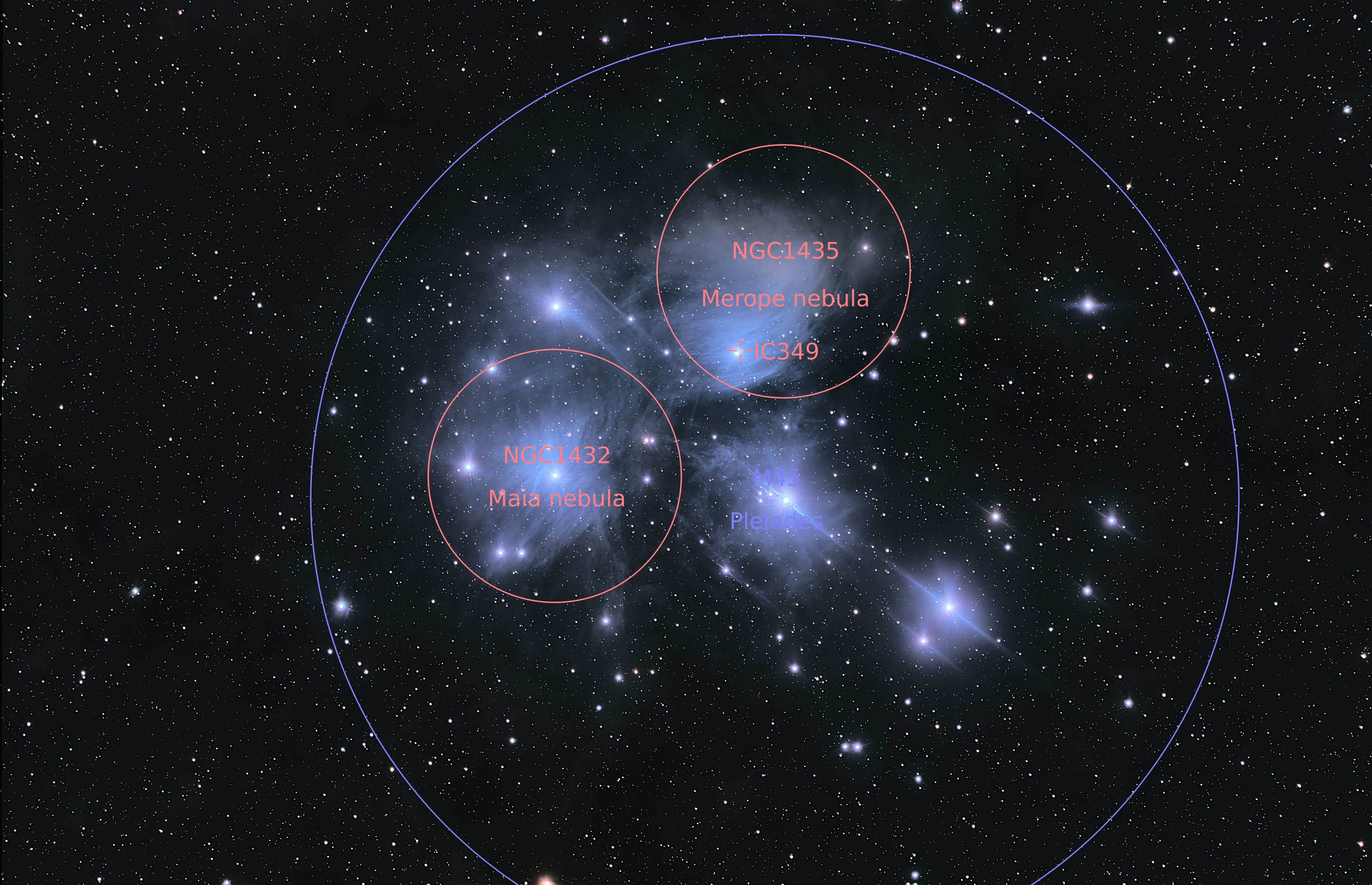
Messier 45 has a faint reflection nebula surrounding it, named Maia Nebula, after one of the cluster’s brightest stars. The nebula is not related to the cluster’s formation, but is merely a dust cloud through which the Pleiades stars are currently passing.
Like other nebulae in the Pleiades cluster, the Maia Nebula has a different radial velocity than the cluster itself, indicating that the two are unrelated and only crossing paths by chance.
Messier 45 has an estimated age of 150 million years. Star formation in the cluster ended at least 80 million years ago.
The cluster is home to more than 1,000 confirmed members, but only a handful of these stars are visible to the naked eye.
The total mass of M45 is estimated at about 800 solar masses.
It is so large that it is 4 times the size of the full Moon.
The Pleiades have been known to cultures around the world since pre-historic times.
The cluster was mentioned in the works of Homer (Iliad and Odyssey, 750 B.C. and 720 B.C.), the prophet Amos (750 B.C.) and Hesiod (700 B.C.) among others.
In Greek mythology, the cluster represents the Seven Sisters, companions of the goddess Artemis and daughters of the sea-nymph Pleione and the Titan Atlas, who held the celestial spheres on his shoulders.
Click Below Image(s) for Full Size:
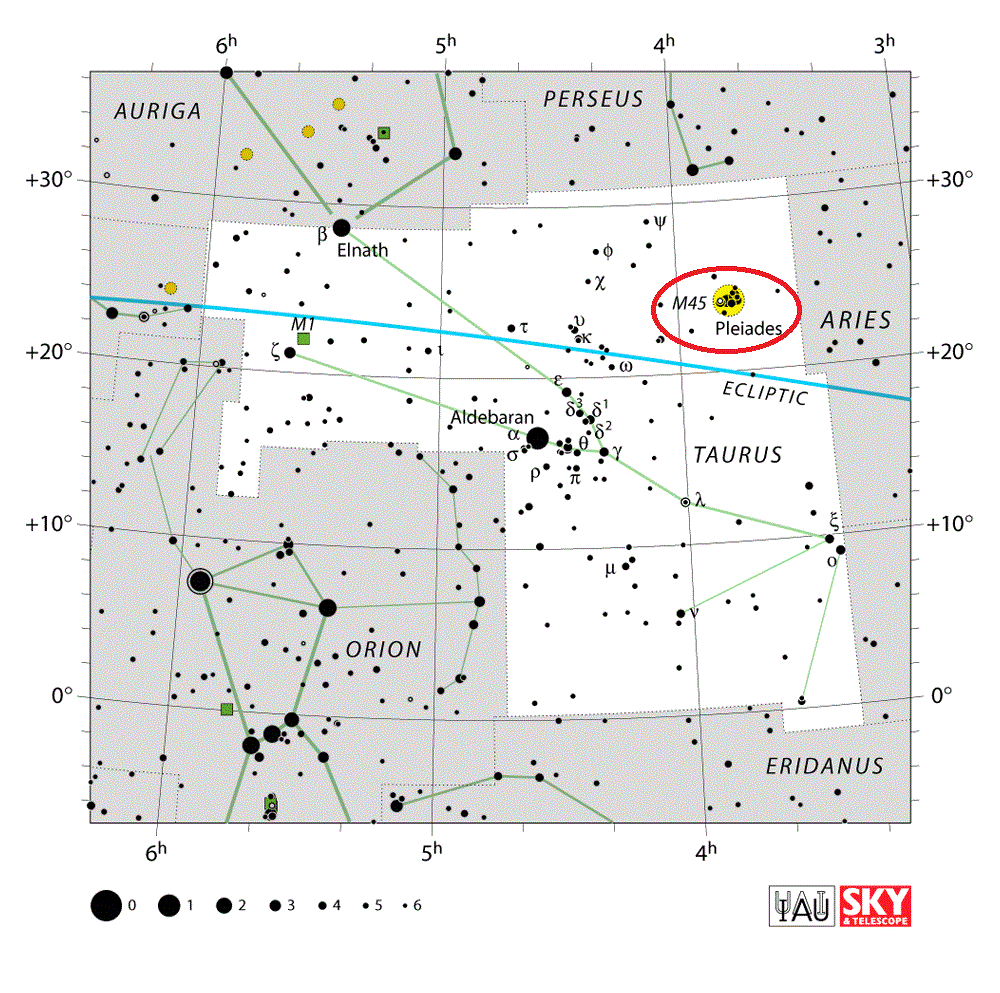
M45 is easily visible with the un-aided eye.
Because of the cluster’s apparent size, the best way to see it is through binoculars and small or wide field telescopes.
Higher magnification is only recommended for studying individual stars.
The best time of year to observe M45 from northern latitudes is during the winter months, when Taurus constellation rises high in the sky.
Platesolve
M45 Open Cluster
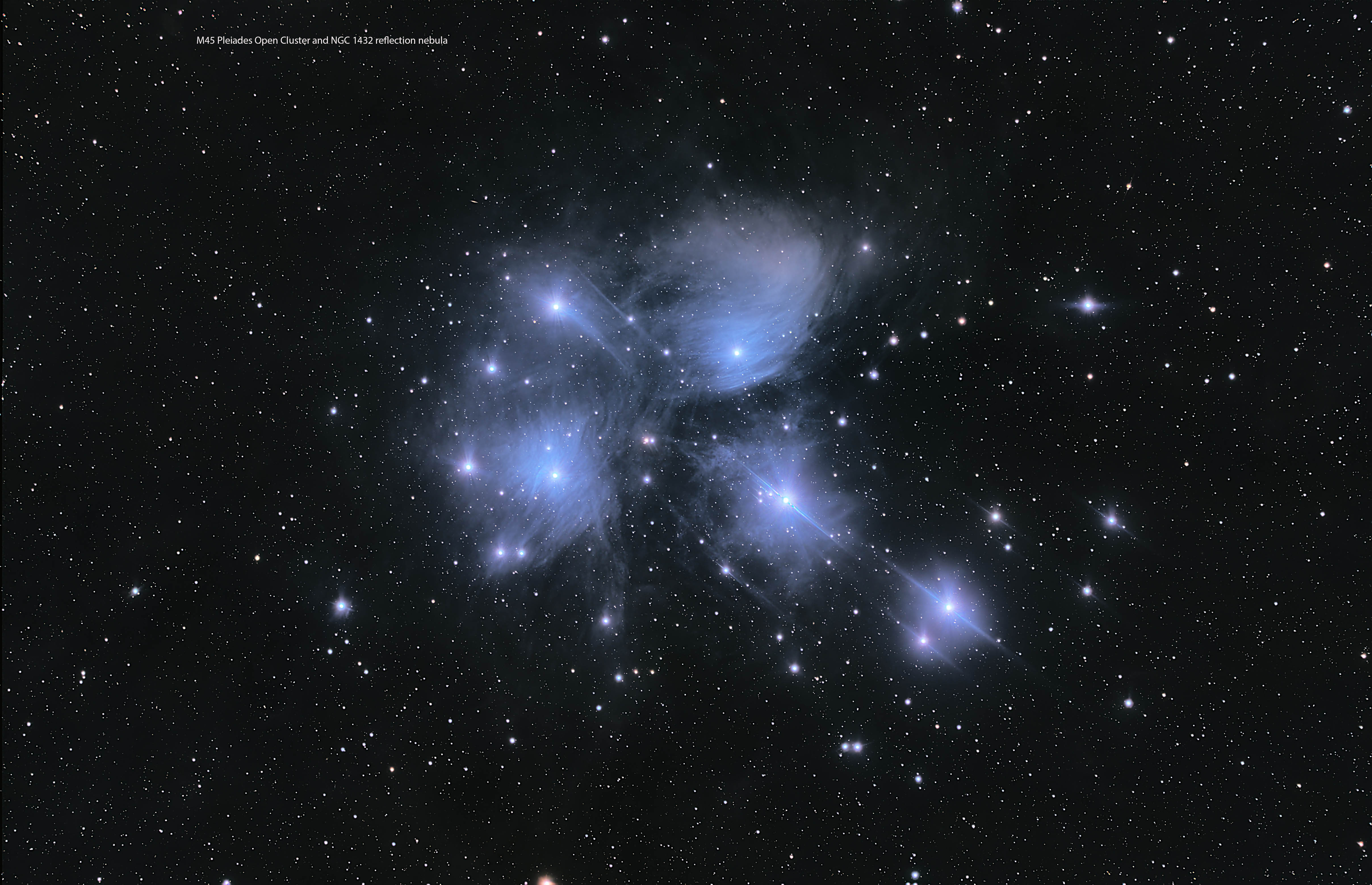
Imaging Details
Click to Return to Home Page