Messier 48 (M48)
Also Known as: NGC 2548, Collinder 179
Object Type: Open Cluster
Constellation: Hydra
Distance from Earth: 1,500 Light years
Apparent Magnitude: 5.5
Coordinates: RA 08H 13.7M 0 DEC -05deg 45min 0sec
Actual Size: 20 light years in diameter
Apparent Dimensions: 32 arc-minutes
Discovered by: Charles Messier added the cluster to his catalogue on February 19, 1771.
However, M48 was considered one of the lost Messier objects for a long time because the coordinates provided by Messier did not match those of NGC 2548: his declination was off by 5 degrees.
Messier described M48 as a “cluster of very small stars, without nebulosity,” noting that “this cluster is at a short distance from the three stars that form the beginning of the Unicorn‘s tail.“
As Messier’s 48th entry was considered lost, the cluster was independently discovered by the German astronomer Johann Elert Bode around 1782 and German-British astronomer Caroline Herschel on March 8, 1783. She noted that the cluster was “at an equal distance from 29 [Zeta] & 30 Monocerotis, making an equilateral triangle with those two stars is a nebulous spot.
By the telescope it appears to be a cluster of scattered stars. It is not in Mess. catalogue.”
It was the German astronomer Oswalt Thomas who identified the cluster as NGC 2458 in 1934.
Canadian astronomer T.F. Morris identified the cluster independently in 1959..
Description: M48 has at least 80 members, including three giant stars of spectral types G to K.
The hottest star in the cluster has the stellar classification A2 and a visual magnitude of 8.8.
It is about 70 times more luminous than the Sun. The estimated age of M48 is 300 million years.
The concentrated central region of M48 stretches across an area more than 30 arc minutes in size.
Click Below Image(s) for Full Size:
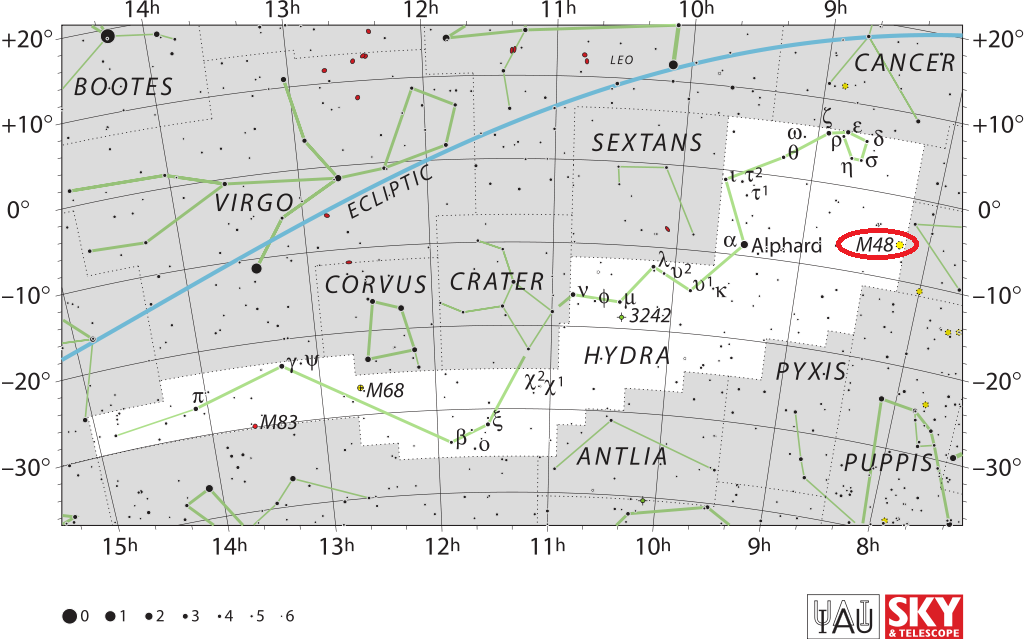
Messier 48 can be seen without binoculars in good conditions.
It lies near the border with the constellation Monoceros, the Unicorn.
The best way to observe M48 is at low magnifications as it covers an area almost twice the size of the full Moon.
The cluster is easily seen in binoculars and small telescopes, which reveal about 50 stars brighter than magnitude 13.
The best time of year to observe the cluster is in the months of December, January and February.
Platesolve
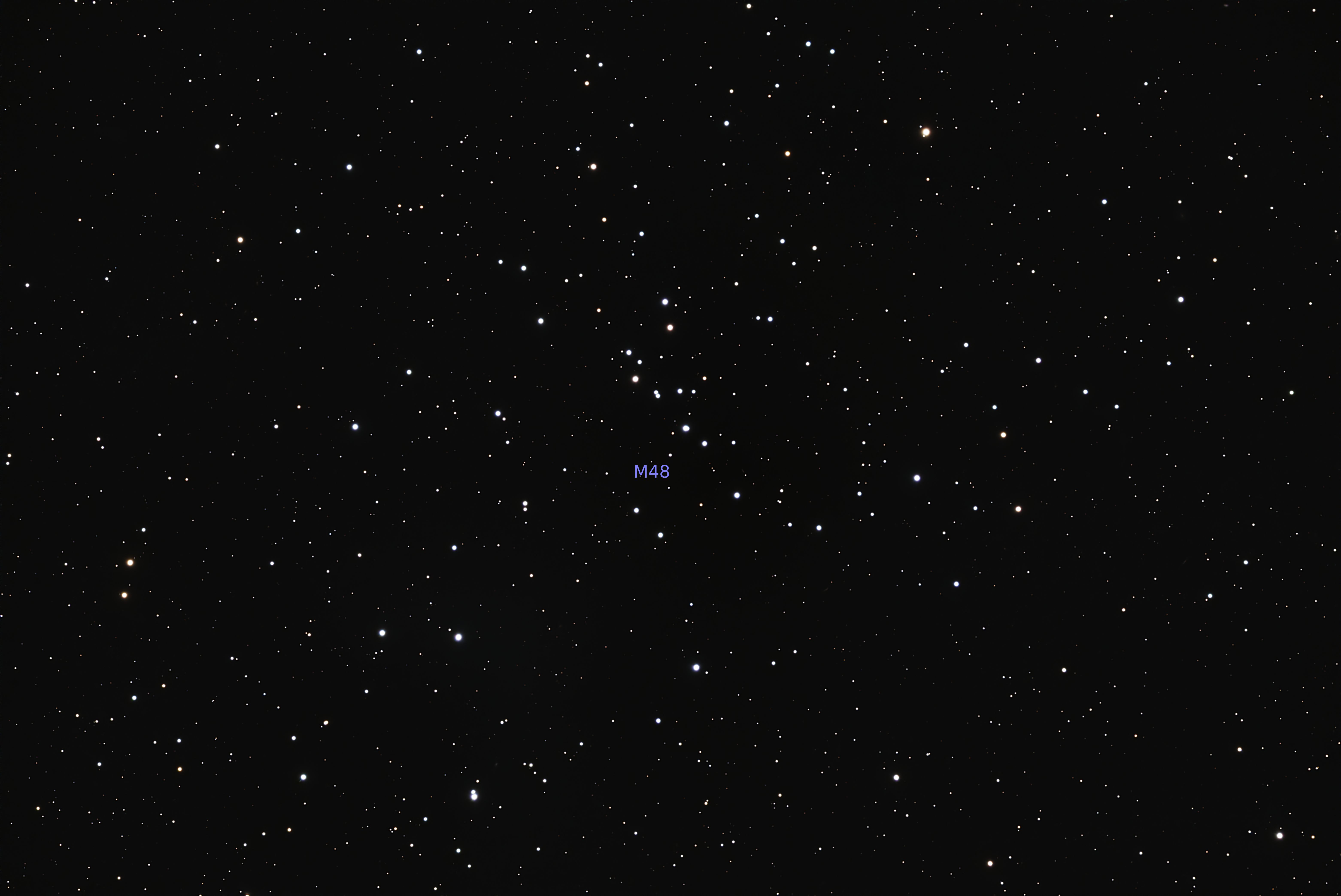
M48 Open Cluster

Imaging Details
Click to Return to Home Page