Messier 53 (M53)
Also Known as: NGC 5024
Object Type: Globular Cluster
Constellation: Coma Berenices
Distance from Earth: 58,000 light years
Apparent Magnitude: 8.33
Coordinates: RA 13H 12M 55.25S DEC 18 deg 10 min 05.4 sec
Actual Size: 220 light years in diameter
Apparent Dimensions: 13 arc-minutes, dense central region is 2 arc-minutes in diameter
Discovered by: Messier 53 was discovered by the German astronomer Johann Elert Bode on February 3, 1775. Describing the object as a “rather conspicuous nebula”.
Charles Messier discovered the cluster independently on February 26, 1777.
Description: M53 lies about 60,000 light years from the galactic center. It is one of the more distant globular clusters.
It is also the most northerly globular cluster. Its central core is visible but more spread out than other clusters.
Messier 53 contains at least 500,000 stars. The stars in the cluster are considered metal-poor, as they contain very little quantities of elements heavier than helium, and are below average in metallicity, even for stars found in a globular cluster.
The estimated age of M53 is 12.67 billion years.
M53 has a density classification V, which means that its central core is visible, but more spread out and less dense than in clusters with classification I to IV.
The overall spectral type of M53 is F6. M53 is approaching us at 112 km/s.
Its central core is about 2 arc-minutes in diameter.
Messier 53 lies in the vicinity of another globular cluster, NGC 5053.
NGC 5053 is considerably fainter, looser and less populated, and can be seen in the same field of view as M53 as it lies only a degree to the east.
Click Below Image(s) for Full Size:
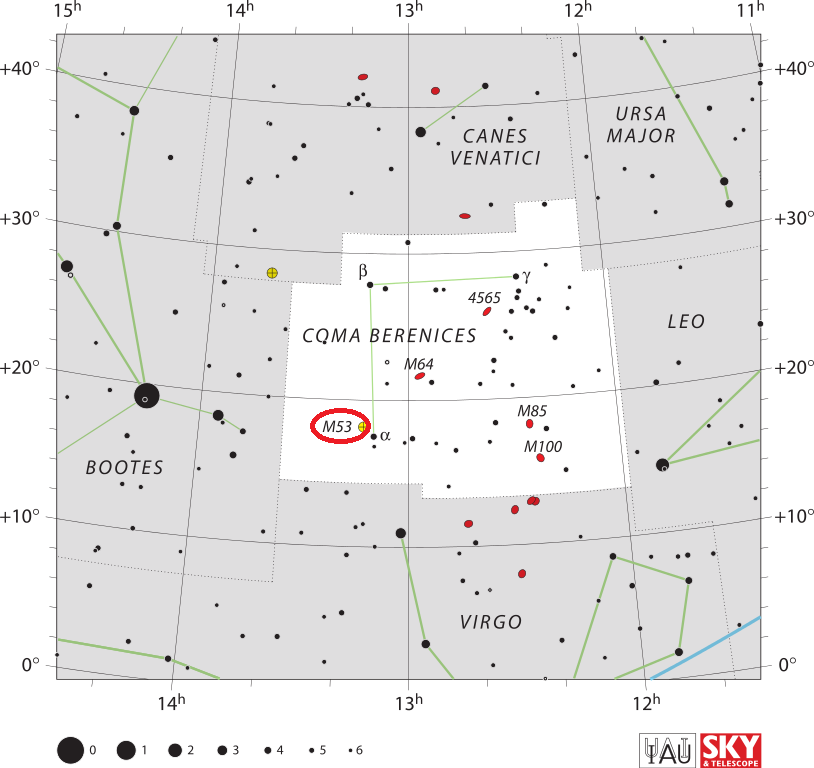
M53 is relatively easy to find. A small telescope reveals a hazy patch slightly oval in shape. At least a medium sized scope is required to resolve the stars.
The best time of year to observe M53 is March-May.
Platesolve
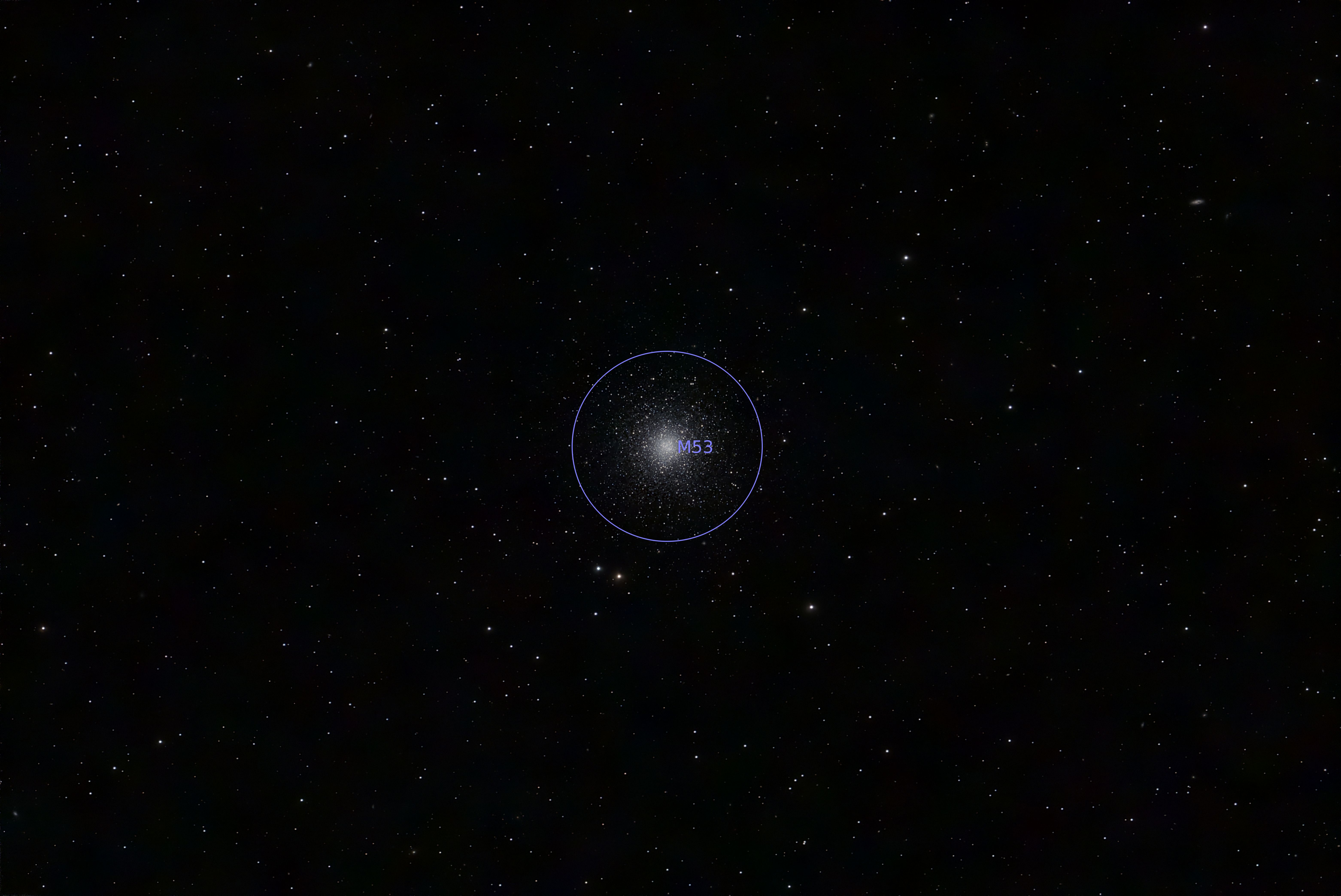
M53 Globular Cluster

Imaging Details
Click to Return to Home Page