Messier 82 (M82)
Common Name: Cigar Galaxy
Also Known as: NGC 3034, ARP 337
Object Type: Irregular Galaxy
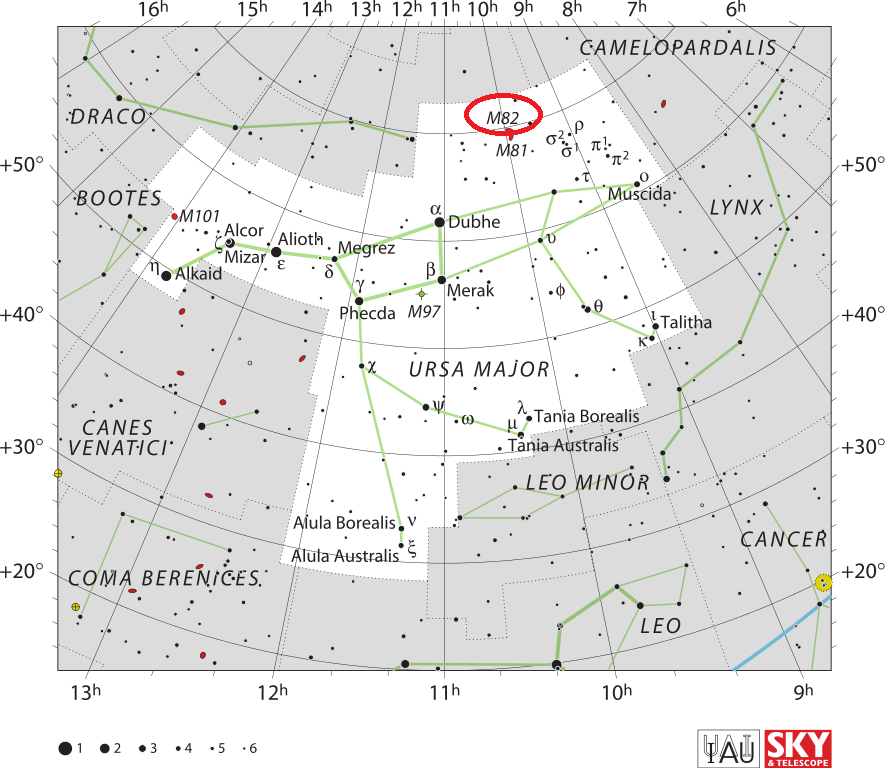
Constellation: Ursa major
Distance from Earth: 11.4 – 12.4 million light years
Apparent Magnitude: 8.41
Coordinates: RA 09H 55M 52.2S DEC 69 deg 49 min 47 sec
Actual Size: 37,000 light years in diameter
Apparent Dimensions: 11.2 arc-minutes x 4.3 arc-minutes
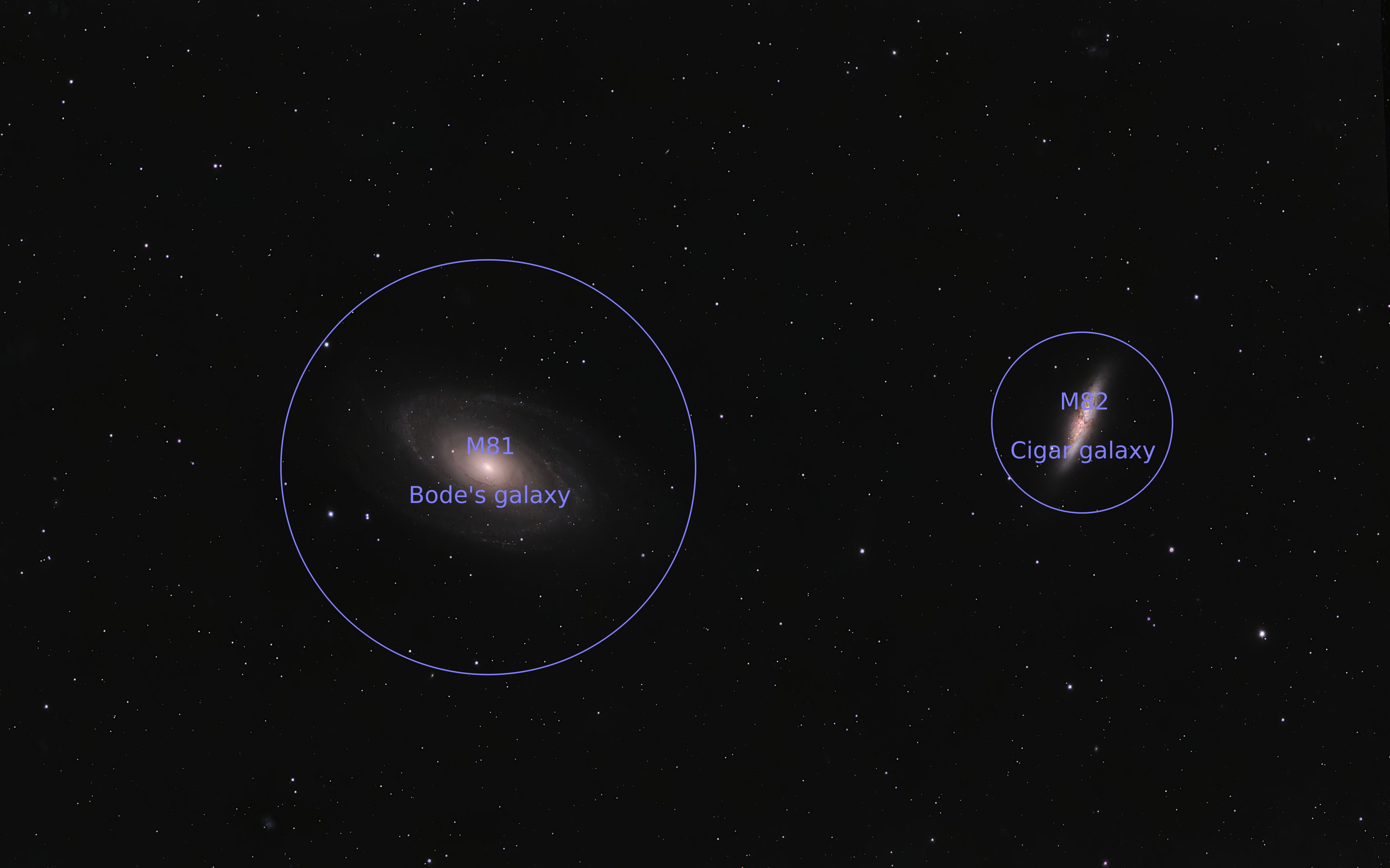
Discovered by: The Cigar Galaxy was discovered by the German astronomer Johann Elert Bode on December 31, 1774 together with the neighboring Messier 81 (Bode’s Galaxy).
Bode described the pair as “two small nebulae 3/4 degrees separated”.
M82 was independently discovered by Johann Gottfried Koehler in 1774.
He described it as a "nebulous patch", this one about 3⁄4 degree away from the other, "very pale and of elongated shape".
Koehler described M81 and M82 as ‘two nebulous stars at the ear of the Great Bear’.
In 1779, Pierre Méchain independently rediscovered both objects and reported them to Charles Messier, who added them to his catalog.
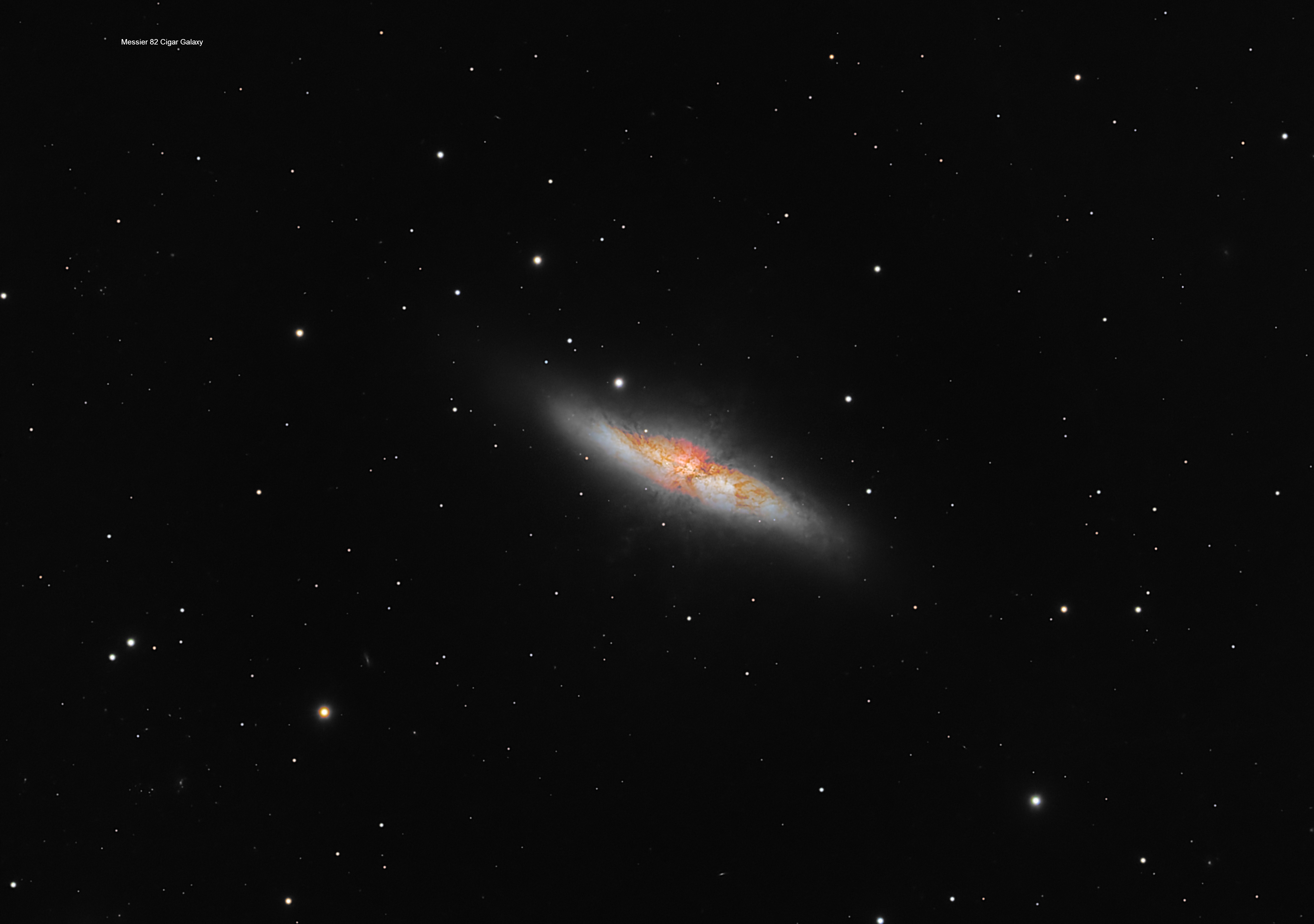
Description: M82 is an edge-on starburst galaxy.
It forms an impressive pair with its large companion, M81. M82 contains 30 billion stars.
The Cigar Galaxy was long believed to be an irregular galaxy. However, near-infrared observations in 2005 revealed two symmetric trailing spiral arms in the galaxy.
The high surface brightness of the galaxy’s disk and our edge-on view of M82 are the main reasons why the spiral arms had not been detected sooner.
M82 is usually classified as irregular, but is probably a distorted disk galaxy and a striking prototype of a class of starburst galaxies.
Messier 82 is about five times more luminous than our galaxy, the Milky Way, and about 100 times more luminous than the Milky Way’s center.
It is the closest starburst galaxy to Earth and serves as a prototype for this type of galaxy. M82 is one of the smallest galaxies listed in the Messier catalogue and inclined about 80 degrees to our view.
The galaxy’s edge-on appearance has earned it the name Cigar.
The galaxy is receding from us at 203 km/s.
The Cigar Galaxy is strongly affected by the interaction with M81, with tidal forces deforming the galaxy in a process that started some 100 million years ago.
As a result of the encounter, star forming activity in M82 has increased tenfold compared to other galaxies.
The star forming activity in M82 is caused by the galaxy’s interaction with its large neighbor, Bode’s Galaxy (M81), the central galaxy in the M81 Group, which also includes M82 and dozens of other galaxies in Ursa Major.
The centers of the Cigar Galaxy and Bode’s Galaxy are visually separated by approximately 130,000 light years.
Click Below Image(s) for Full Size:
In binoculars and small telescopes the Cigar Galaxy appears as a thin rod of light.
Large scopes (6 and 8 inch) reveal the bright core and dark patches across the galaxy’s surface. Larger scopes show more details.
Best time to view M82 is during the spring months.
Platesolve
M82 Irregular Galaxy

Imaging Details
M82 Irregular Galaxy
Imaging Details
Click to Return to Home Page