Messier 98 (M98)
Also Known as: NGC 4192
Object Type: Intermediate Spiral Galaxy
Constellation: Coma Berenices
Distance from Earth: 44.4 million Light years
Apparent Magnitude: 10.1
Coordinates: RA 12H 13M 48.292S DEC 14deg 54min 01.69sec
Actual Size: 160,000 light years in diameter
Apparent Dimensions: 9.8 arc-minutes x 2.8 arc-minutes
Discovered by: Messier 98 was discovered by the French astronomer Pierre Méchain on March 15, 1781, along with the unbarred spiral Messier 99 and the grand design spiral galaxy Messier 100.
Both these galaxies are located in the same region of the sky.
Charles Messier determined the position for the object and added it to his catalogue on April 13, 1781, after completing the third edition. He offered the following description of M98:
"Nebula without star, of an extremely faint light, above the northern wing of Virgo, on the parallel & near to the star no. 6, fifth magnitude, of Coma Berenices". Méchain saw it on Mar 15, 1781.
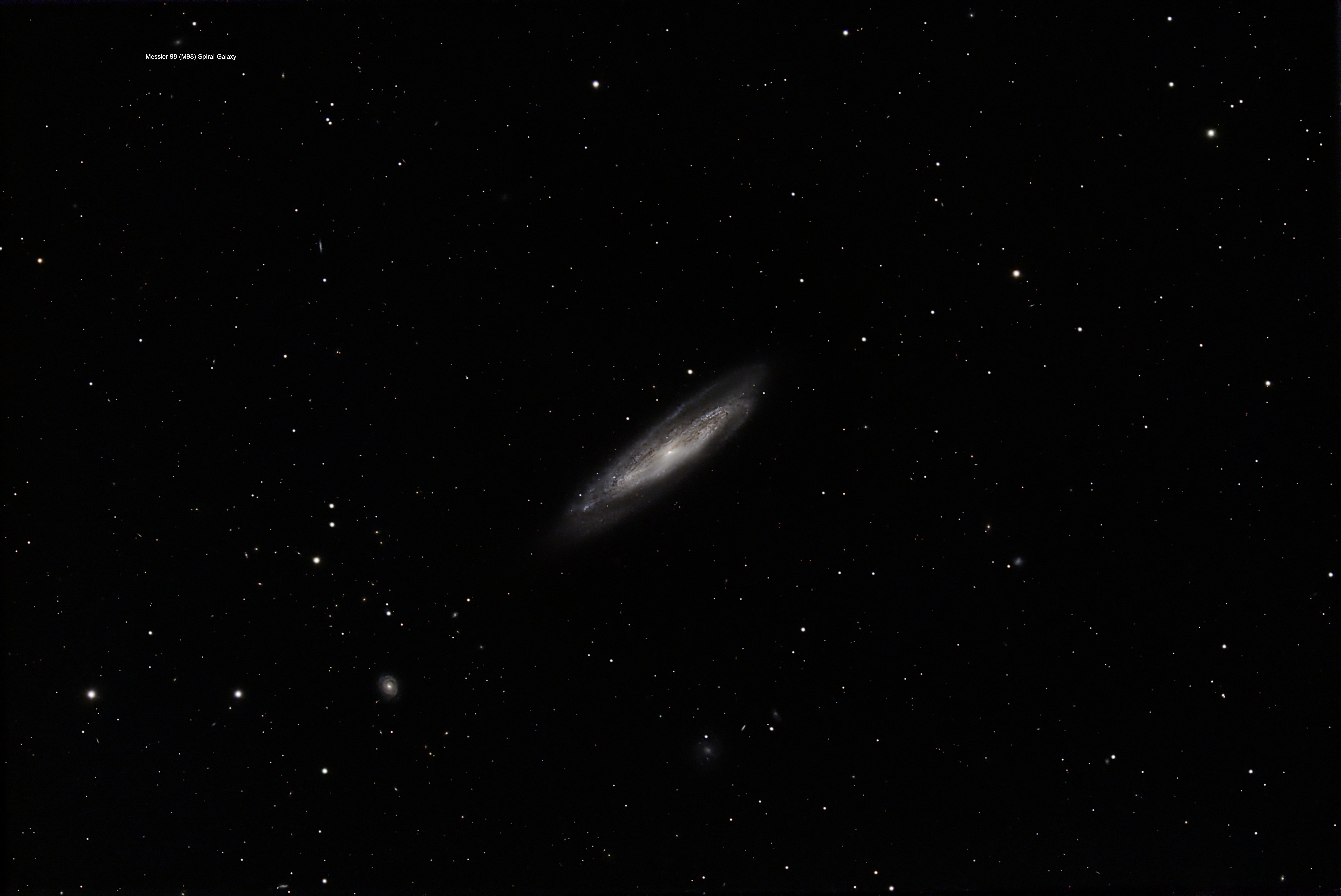
Description: The classification of M98 is SAB(s)ab indicates that M98 is a spiral galaxy with mixed barred and non-barred features and intermediate to tightly wound spiral arms, with no ring.
The galaxy has a rotation velocity of up to 236 km/s and is approaching us at 142 km/s. It is one of the most remote blueshifted large galaxies.
Messier 98 is estimated to contain about a trillion stars. The stars in the galaxy have a total mass of 76 billion solar masses.
M98 also contains about 4.3 billion solar masses of neutral hydrogen gas and 85 million solar masses of interstellar dust.
The nucleus of M98 is active, exhibiting LINER-type (low ionization nuclear emission region) characteristics, and surrounded by an H II region.
Because of the high amounts of gas and dust, there are numerous star-forming regions in the galaxy, especially in its nucleus and arms. The nucleus itself is “active,” meaning that the center of the galaxy is more luminous than the rest of the galaxy.
The light of the nucleus is obscured by a large amount of dust in the galaxy’s disturbed, elongated disk, which also contains numerous star forming regions.
The dust was produced during tidal collisions and interactions with neighboring galaxies.
M98 is highly inclined to the line of sight at an angle of 74° and has a maximum rotation velocity of 236 km/s.
Messier 98 is a member of the Virgo Cluster, which is a large cluster of galaxies, part of the local supercluster.
M98 is one of a small number of galaxies that are blueshifted. The vast majority of galaxies are receding from us and display redshifts.
However, due to the movement of M98 within the Virgo cluster it's currently falling towards us and hence the blueshift.
Click Below Image(s) for Full Size:

M98 is one of the faintest objects in the Messier catalogue and, having a low surface brightness, one of the most difficult Messier objects to observe.
M98 requires exceptionally clear, dark skies and at least a 4-inch telescope. 8-inch telescopes reveal a thin, hazy streak of light with a slightly brighter center, while larger amateur telescopes show the nucleus more clearly.
The best time of year to observe the galaxies is during the spring.
Platesolve

M98 Spiral Galaxy
Imaging Details
Click to Return to Home Page