NGC 1976
Common Name: Orion Nebula
Also Known as: Messier 42 (M42), Great Orion Nebula, Sharpless 281
Object Type: Emission/Reflection Nebula
Constellation: Orion
Distance from Earth: 1,344 light years
Apparent Magnitude: 4.0
Coordinates: RA 05H 37M 17.3S DEC -05 deg 23 min 28 sec
Actual Size: 24 light years in diameter
Apparent Dimensions: 65 arc-minutes x 60 arc-minutes
Discovered by:
Ptolemy catalogued the nebula as a single bright star in 130 AD, as did Danish astronomer Tycho Brahe in the late 16th century and German astronomer Johann Bayer in 1603.
Bayer catalogued it as Theta Orion in his star atlas Uranometria. Galileo saw several faint stars in the region in 1610, but did not see the surrounding nebula.
The first to identify M42 as a nebula was the French astronomer Nicolas-Claude Fabri de Peiresc, who observed it with a refractor on November 26, 1610.
Swiss Jesuit astronomer and mathematician Johann Baptist Cysat is credited for the first published observation of the Orion Nebula. The nebula was included in his monograph on the comets, published in 1619.
English astronomer and physicist Edmond Halley included the Orion Nebula in his list of six nebulae in 1716.
Charles Messier discovered the nebula and the three stars in the Trapezium Cluster on March 4, 1769,
Description: M42 is the famous emission-reflection nebula being one of the brightest nebulae in the sky.
The nebula has a mass 2,000 times that of the Sun and contains associations of stars, reflection nebulae, neutral clouds of dust and gas, and ionized gas.
It is part of the Orion Molecular Cloud Complex, a larger region of nebulosity that also includes the famous Horsehead Nebula, the Flame Nebula, the emission nebula Barnard’s Loop, De Mairan’s Nebula (M43), and the reflection nebula Messier 78.
The Orion Molecular Cloud Complex covers an area of more than 10 degrees, which is more than half of Orion constellation. Different parts of the Orion Nebula have been given different names.
The bright regions to the sides of the nebula are known as the Wings and the dark lane stretching from the north toward the illuminated region is called the Fish’s Mouth.
The wing extension to the south is known as the Sword, the fainter extension to the west is called the Sail, and the bright nebulous region under the Trapezium Cluster has been nicknamed the Thrust.
Messier 42 contains hundreds of very young stars, less than a million years old, and also protostars still embedded in dense gas cocoons.
The nebula is home to about 700 stars in different stages of formation. The youngest and brightest members are believed to be less than 300,000 years old, and the brightest of these may be as young as 10,000 years old.
The Orion Nebula is a place of massive star formation and one of the most studied deep sky objects in our vicinity as it allows astronomers to study the process of stars forming from clouds of dust and gas and the photo-ionizing effects of massive young stars that are responsible for the nebula’s glow.
The stars in the Trapezium Cluster emit ultraviolet radiation, heating the surrounding gas and illuminating the nebula.
Their stellar winds are also eroding and sculpting the nebula. Most of the ultraviolet ionizing radiation comes from Theta-1 Orionis C, the most massive of the four bright stars in the Trapezium Cluster and one of the most luminous stars known.
In about 100,000 years most of the nebula will be gone leaving behind a bright young open cluster.
Click Below Image(s) for Full Size:
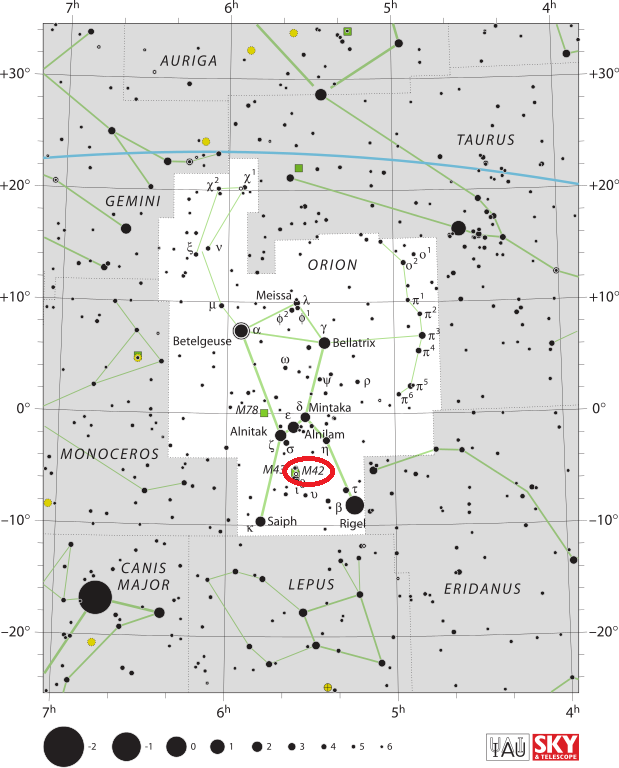
With an apparent magnitude of 4.0, the Orion Nebula is one of the brightest nebulae in the sky and is visible to the naked eye.
It can easily be seen with binoculars and small telescopes. Covering more than 1 degree it is 4 times the size of the full Moon.
Even small telescopes can resolve the 4 brightest stars in the Trapezium cluster which is an open cluster within M42.
M42 is best observed during the winter months.
Platesolve
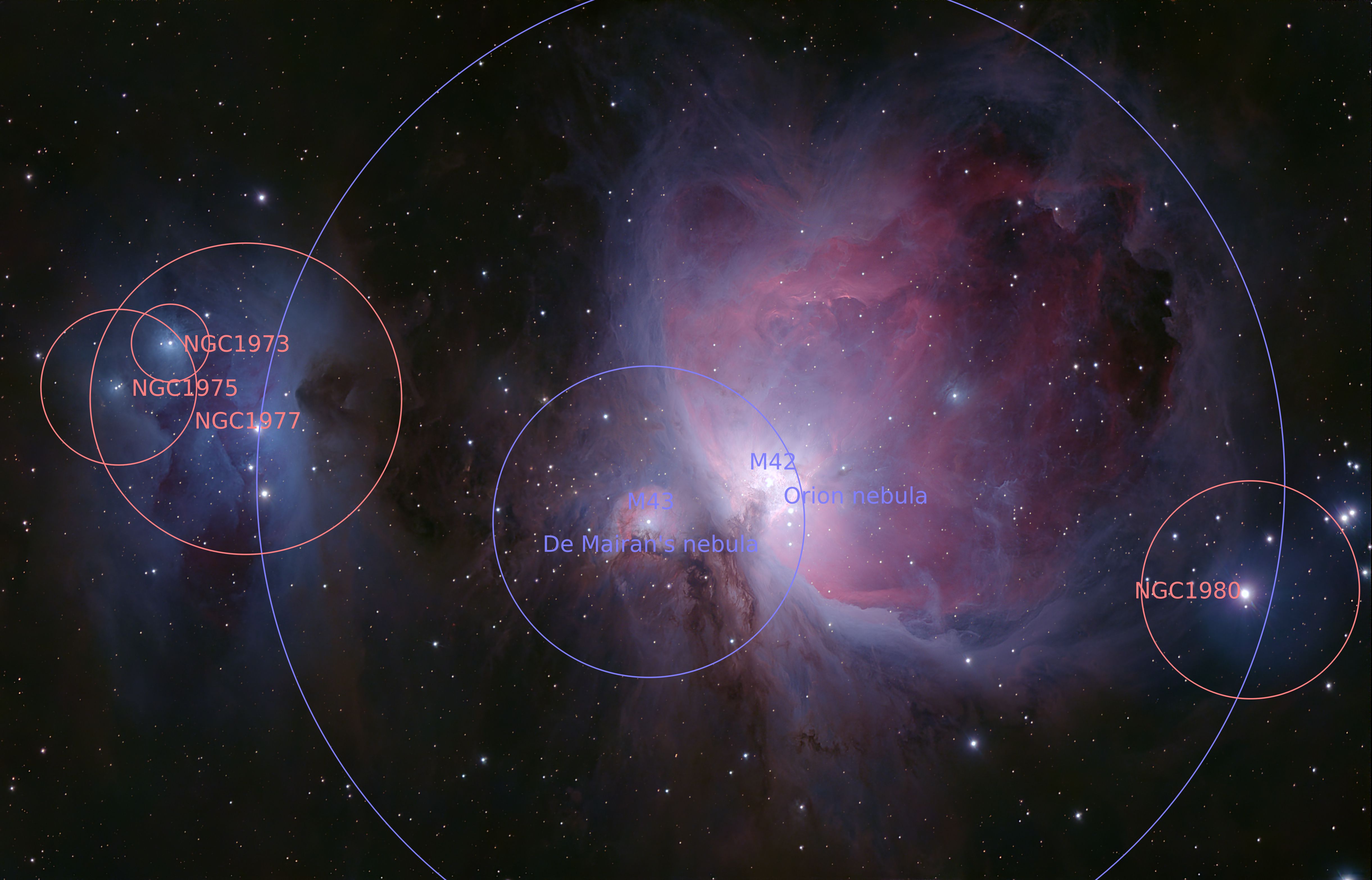
NGC 1976 Nebula

Imaging Details
Click to Return to Home Page