NGC 5053
Also Known as: Cr 257, C 1313+179
Object Type: Globular Cluster
Constellation: Coma Berenices
Distance from Earth: 57 light years
Apparent Magnitude: 10.5
Coordinates: RA 13H 16M 27.09 Sec DEC 17 deg 42 min 00.9 sec
Actual Size: 100 light years
Apparent Dimensions: 10.5 arcminutes
Discovered by: NGC 5053 was discovered by German-British astronomer William Herschel on March 14, 1784 and cataloged as VI-7.
In his abbreviated notation, he described it as, "an extremely faint cluster of extremely small stars with resolvable nebula 8 or 10′ diameter, verified by a power of 240, beyond doubt".
Danish-Irish astronomer John Louis Emil Dreyer reported in 1888 that the cluster appeared, "very faint, pretty large, irregular round shape, growing very gradually brighter at the middle".
Description:
NGC 5053 is a metal-poor cluster, meaning the stars have a low abundance of elements other than hydrogen and helium—what astronomers term metallicity.
As recently as 1995, it was considered the most metal-poor globular cluster in the Milky Way.
The chemical abundances of the stars in NGC 5053 are more similar to those in the dwarf galaxy Sagittarius Dwarf Spheroidal Galaxy than to the Milky Way halo.
Along with the kinematics of the globular cluster, this suggests that NGC 5053 may have been stripped from the dwarf galaxy.
NGC 5053 is a relatively low mass cluster with a low core concentration factor of 1.32.
It sports a stream of tidal debris to the west with a projected length of 1.7 kpc. This stream may have been created through shock-induced processes.
The cluster is located less than 1° from Messier 53 and the two have nearly the same distance modulus, which corresponds to a spatial separation of around 2 kpc.
There is a tidal bridge joining M53 to NGC 5053, suggesting the pair may have interacted in the past.
NGC 5053 has very few stars for a globular cluster. With a diameter of approx. 100 light years, it contains only approx. 3500 stars - which results in a low density of 0.3 stars per cubic parsec.
Click Below Image(s) for Full Size:
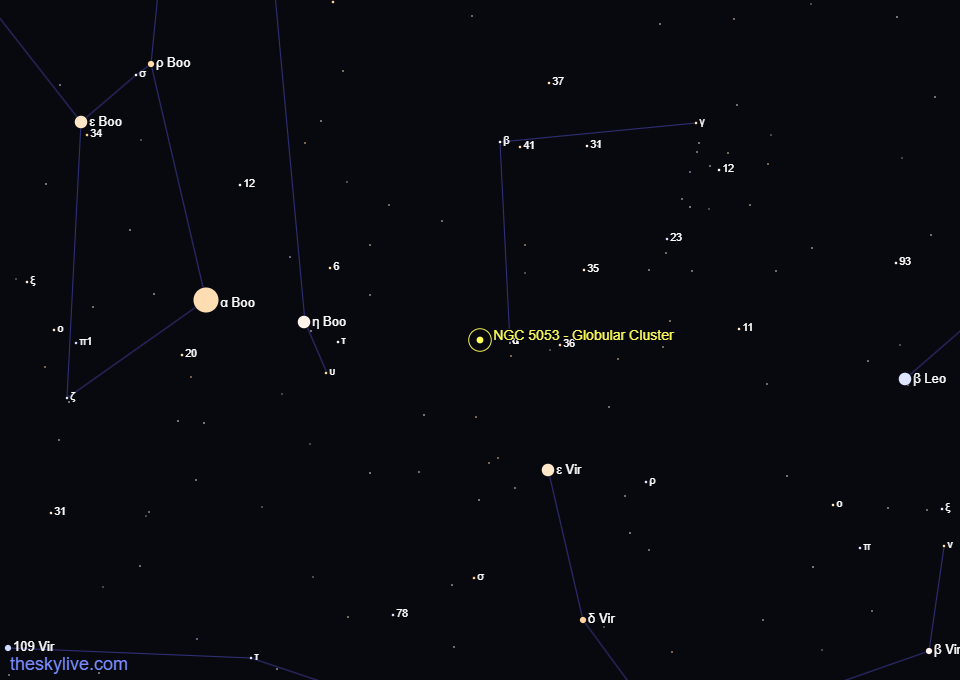
NGC 5053 is a Globular Cluster in the Coma Berenices constellation. It appears more like an open cluster than a globular cluster.
NGC 5053 is situated close to the celestial equator and, as such, it is at least partly visible from both hemispheres in certain times of the year.
Given its visual magnitude, NGC 5053 is visible with the help of a binocular with a 80mm aperture or a small telescope.
Platesolve
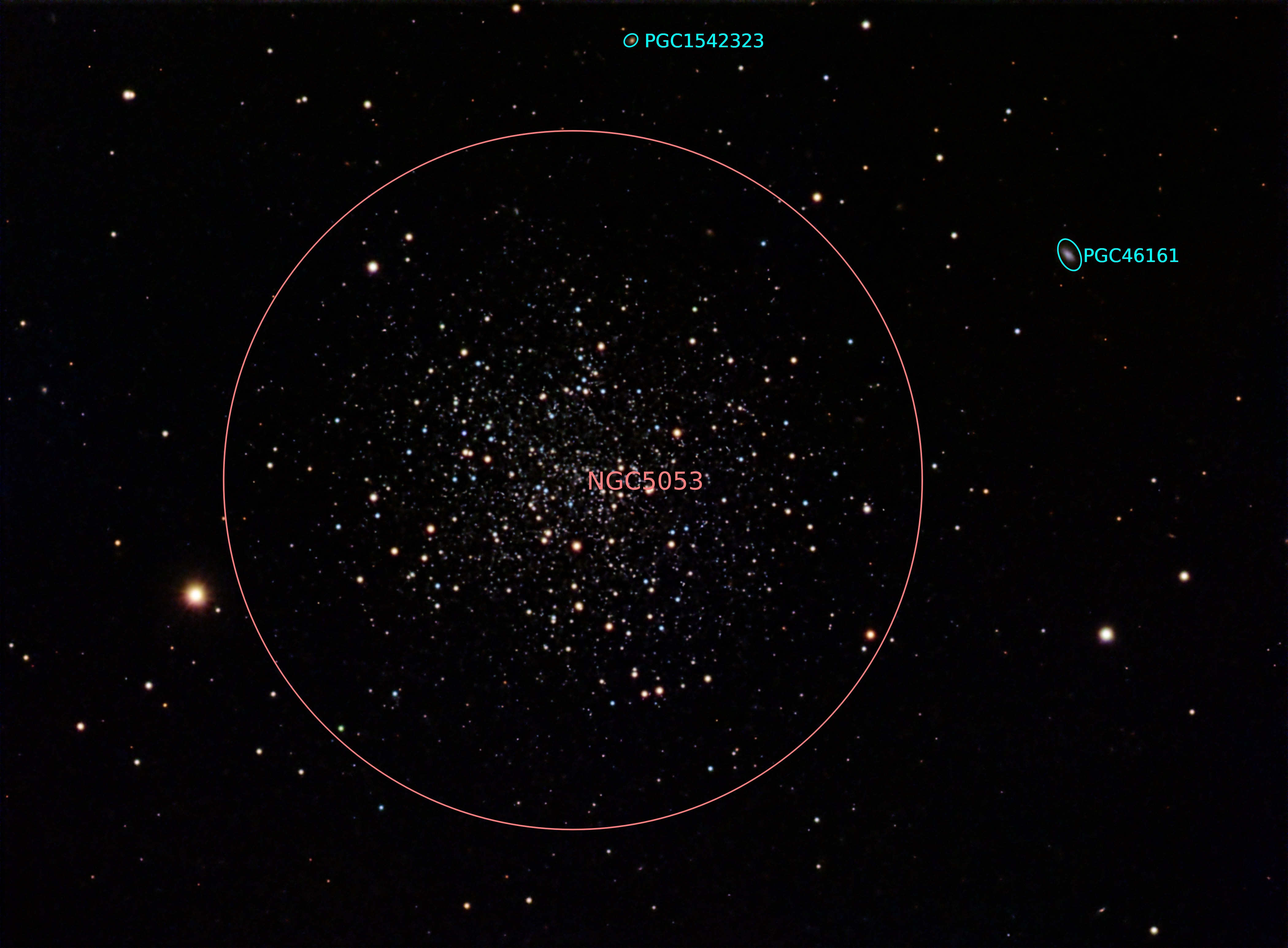
NGC 5053 Globular Cluster

Imaging Details
Click to Return to Home Page