NGC 5866
Common Name: Spindle Galaxy
Also Known as: Messier 102 (M102)
Object Type: Lenticular Galaxy
Constellation: Draco
Distance from Earth: 50 million light years
Apparent Magnitude: 10.7
Coordinates: RA 15H 06M 29.5S DEC 55 deg 45 min 48 sec
Actual Size: 70,000 light years in diameter
Apparent Dimensions: 4.7 arc-minutes x21.9 arc-minutes
Discovered by: The Spindle Galaxy was most likely discovered either by Pierre Méchain or Charles Messier in 1781.
Méchain documented M102 in late March or early April, 1781, describing the object as a “nebula between the stars Omicron Boötis & Iota Draconis,” adding that “it is very faint; near it is a star of the sixth magnitude.”.
Méchain probably meant Theta Boötis, not Omicron, which contributed to the confusion around the identity of M102. Omicron Boötis is more than 40 degrees away from Iota Draconis, which makes the possibility of an error very likely. Méchain reported the discovery to Messier, who added the object to his catalogue without providing a position. Messier later gave a handwritten position for M102 in his personal copy.
Description: M102 is an edge-on Lenticular galaxy and is estimated to contain 100 billion stars.
The galaxy may have been misidentified as a lenticular galaxy and may in fact be a spiral, which would make the dust disk far less unusual.
M102 is moving away at 672 km/s.
The galaxy may have had interactions with other galaxies since the central dust lane appears warped.
The Spindle Galaxy is one of the brightest members of the NGC 5866 Group, or M102 Group, a small group of galaxies that also includes the nearby NGC 5907, NGC 5879, NGC 5870, NGC 5866A and NGC 5866B, UGC 9776 and PGC 54577.
Numerous fainter background galaxies can be seen in the same area of the sky, including the relatively bright pair NGC 5905/NGC 5908 and the galaxies NGC 5862, NGC 5867, NGC 5874, NGC 5876 and IC 1099.
The north celestial pole passes through M102 every 25,800 years.
It has a prominent extended central dust disk that appears almost exactly edge-on when seen from Earth.
The dust disk is very unusual for a galaxy of this type.
Lenticular galaxies typically have dust only near the central region and the dust follows the light profile of the galactic bulges.
The dust disk in M102 may contain a ring structure, but the shape of the structure is difficult to determine because the galaxy is seen edge-on.
Click Below Image(s) for Full Size:
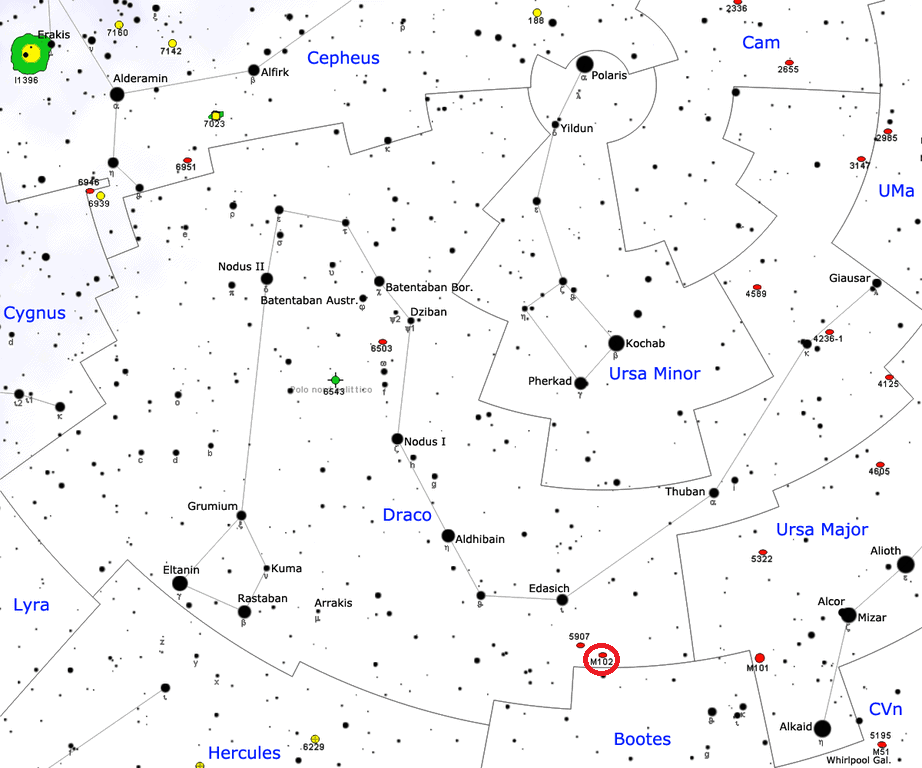
It is very difficult to see with binoculars, but easily visible in small telescopes, which show a thin, nebulous patch under good conditions.
4-inch telescopes show a bright elliptical nebulous patch with a brighter core, while 6-inch and 8-inch instruments reveal a halo of light and hints of the galaxy’s dark dust lane.
Larger telescopes show the galaxy’s well-defined bright center and more details of its structure.
Observers north of latitude 35N can see the galaxy throughout the year as it is circumpolar and never sets below the horizon.
Platesolve
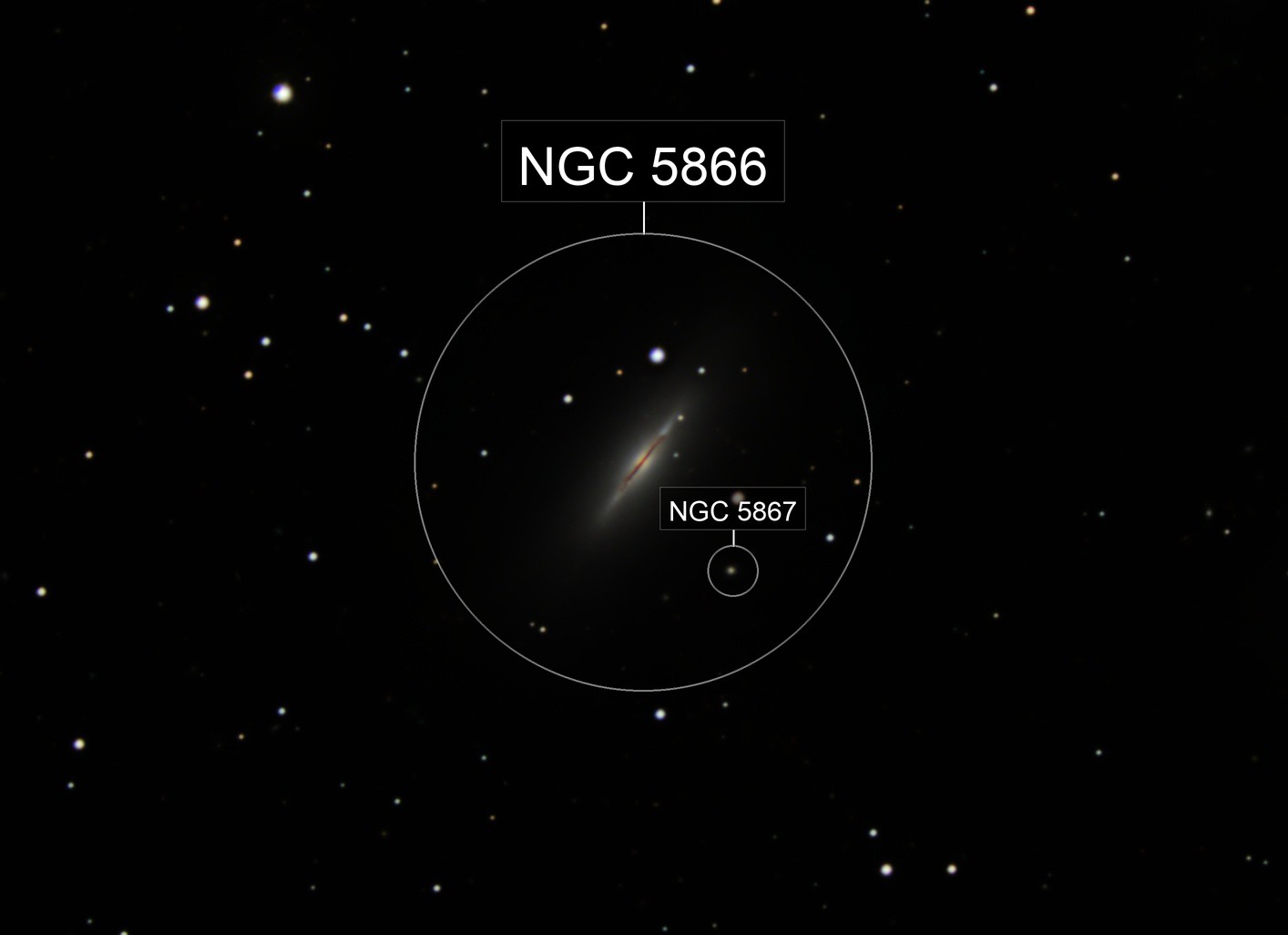
NGC 5866 Galaxy
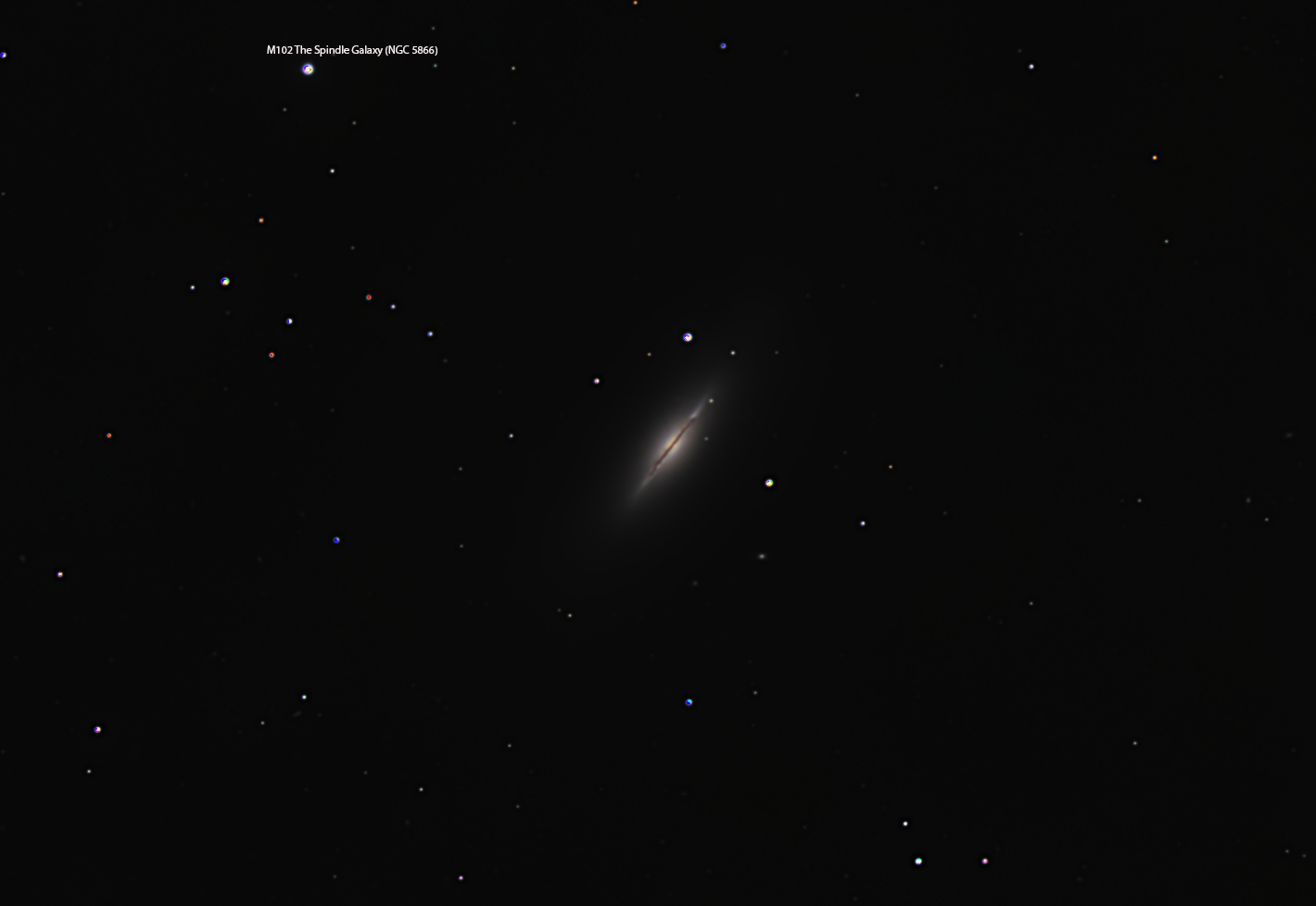
Imaging Details
Click to Return to Home Page