NGC 6992
Common Name: Eastern Veil Nebula
Also Known as: IC 1340, Cygnus Loop. Cirrus Nebula, Filamentary Nebula
Object Type: Supernova Remnant
Constellation: Cygnus
Distance from Earth: 2,400 light years
Apparent Magnitude: 7.0
Coordinates: RA 20H 45M 38S DEC 30 deg 42 min 30 sec
Actual Size: 130 light years in diameter.
Apparent Dimensions: 2 degrees.
Discovered by: The nebula was discovered on 5 September 1784 by William Herschel.
He described the western end of the nebula as "Extended; passes thro' 52 Cygni... near 2 degree in length", and described the eastern end as "Branching nebulosity ... The following part divides into several streams uniting again towards the south.
Description: NGC 6992, the Eastern Veil Nebula is a large supernova remnant in the constellation Cygnus.
The Eastern Veil Nebula is a large supernova remnant in the constellation Cygnus. It is an expanding cloud created by the death of an exploded star.
Scientists believe that the light from this supernova explosion reached Earth about 5000 years ago.
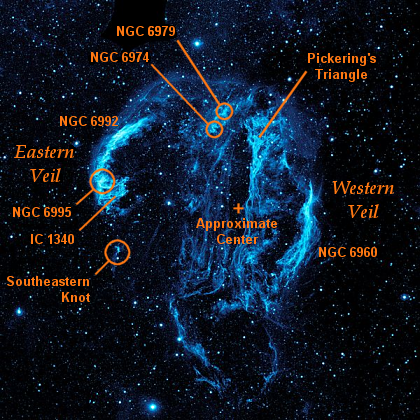
The complete Veil Nebula complex (The Cygnus Loop) contains three prominent deep sky objects, the Eastern Veil, the Western Veil, and Pickering’s Triangle.
The ‘eastern’ portion is just a section of a much larger nebula complex known as the Cygnus Loop. This region also includes the Witches Broom Nebula (Western Veil Nebula, NGC 6960),
and the Bat Nebula (IC 1340).
The oxygen, sulfur, and hydrogen composition of this nebula make it a popular choice for deep sky astrophotographers.
The wispy filaments of the Eastern Veil Nebula are a part of a larger overall network of nebulae in this area of the sky, called the Cygnus Loop.
The Western Veil Nebula is equally as stunning as this target. The brighter segments of the nebula have the New General Catalogue designations NGC 6960, 6974, 6979, 6992, and 6995.
NGC 6992 & 6995 are objects on the eastern side of the loop which are also relatively easy to see. NGC 6974 and NGC 6979 are visible as knots in an area of nebulosity along the northern rim.
Pickering's Triangle is much fainter, and has no NGC number (though 6979 is occasionally used to refer to it).
The Veil Nebula is expanding at a velocity of about 1.5 million kilometers per hour
Click Below Image(s) for Full Size:
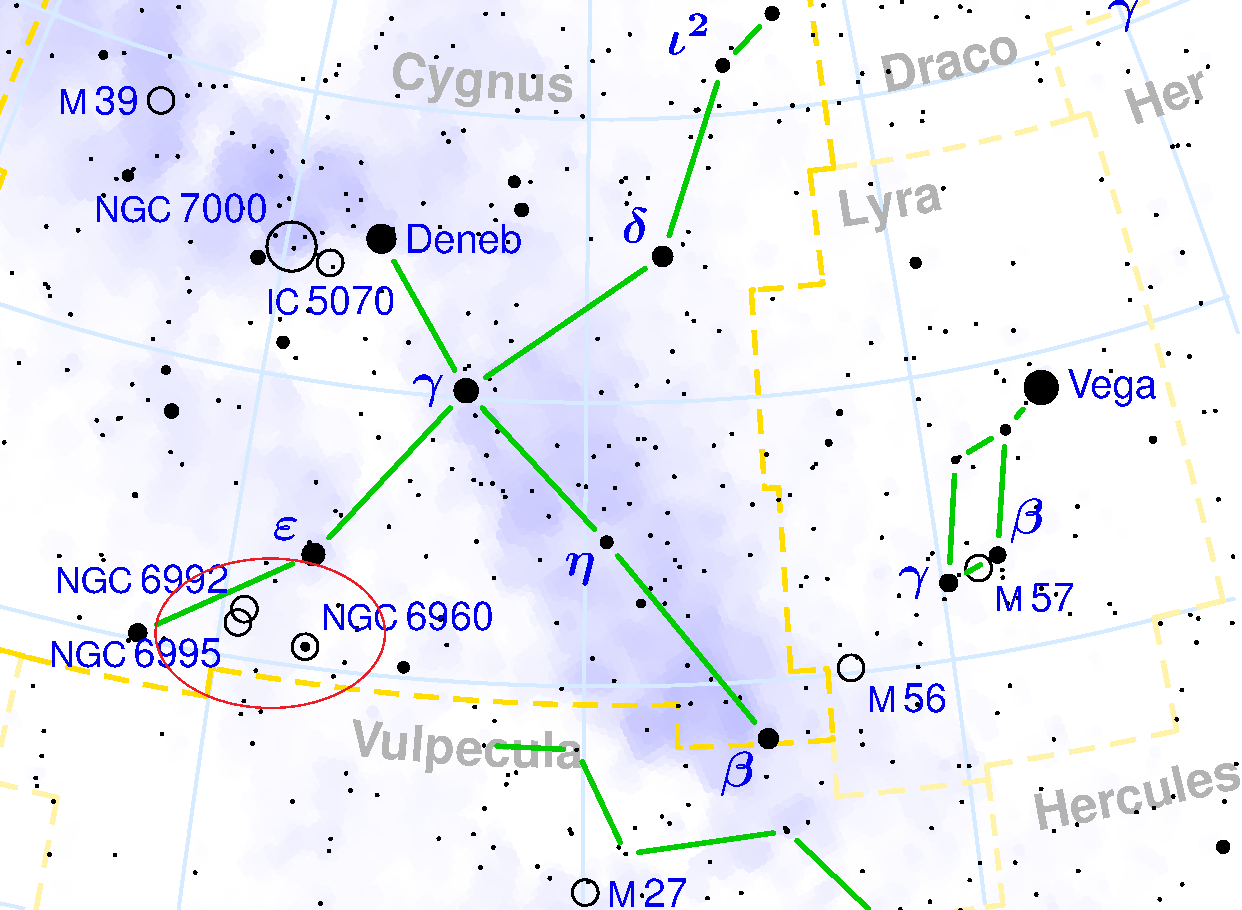
The easiest segment to find is 6960, which runs behind 52 Cygni, a star that can be seen with the naked eye.
A telescope with at least 8-inches of aperture, such as a Dobsonian reflector will show a faint glow in from the Veil Nebula through the telescope eyepiece.
The best time to observe NGC 6992 is the summer months when Cygnus is high in the night sky
Platesolve
NGC 6992 Supernova Remnant

Imaging Details
Click to Return to Home Page