NGC 7331
Also Known as: Caldwell 30
Object Type: Unbarred Spiral Galaxy
Constellation: Pegasus
Distance from Earth: 39.8 million light years
Apparent Magnitude: 10.4
Coordinates: RA 22H 37M 04.1S DEC 34 deg 24 min 56 sec
Actual Size: 120,000 light years in diameter.
Apparent Dimensions: 10.5 arc-minutes x 3.7 arc-minutes
Discovered by: NGC 7331 discovered by William Herschel in 1784.
Description: NGC 7331 is an unbarred spiral galaxy in the constellation Pegasus.
NGC 7331 is the brightest galaxy in Pegasus. This spiral galaxy was one of William Herschel's earliest discoveries over 200 years ago. Although visible in large binoculars, it was missed by Messier.
NGC 7331 is the brightest member of the NGC 7331 Group, also known as the Deer Lick Group. The visual grouping is not a real galaxy group because NGC 7331 lies much closer to us than the other galaxies and is not physically associated with them.
The galaxies were nicknamed the Deer Lick Group by amateur astronomer Tom Lorenzin, who observed NGC 7331 and its smaller companions from the Deerlick Gap Overlook in the mountains of North Carolina in the 1980s.
The smaller background galaxies are affectionately known as the “fleas.”
The other galaxies lie at distances of 290-370 million light-years and appear much smaller than NGC 7331.
The NGC 7331 Group is catalogued as LGG 459 in the Lyons Groups of Galaxies (LGG) catalogue. Central bulge rotates in the opposite direction to the disk, which is unusual. In spiral galaxies, the bulge typically rotates with the disk.
NGC 7331 has a star forming ring about 20,000 light-years from the galactic nucleus. The ring of dust and gas stands out in yellowish hues in the infrared image taken by the Spitzer Space Telescope.
It is composed in large part of organic compounds known as polycyclic aromatic hydrocarbons (PAHs). Based on the data obtained with Spitzer, the ring has enough gas to produce four billion Sun-like stars.
The galaxy is similar in size and structure to the Milky Way, and is sometimes referred to as "the Milky Way's twin". However, discoveries in the 2000s regarding the structure of the Milky Way may call this similarity into doubt,
particularly because the latter is now believed to be a barred spiral, compared to the unbarred status of NGC 7331.
In spiral galaxies the central bulge typically co-rotates with the disk but the bulge in the galaxy NGC 7331 is rotating in the opposite direction to the rest of the disk.
In both visible light and infrared photos of the NGC 7331, the core of the galaxy appears to be slightly off-center, with one side of the disk appearing to extend further away from the core than the opposite side.
Click Below Image(s) for Full Size:

NGC 7331 is situated north of the celestial equator and, as such, it is more easily visible from the northern hemisphere.
For visual observers NGC 7331 is a pretty easy target. It should be visible in binoculars from a dark site but a 100mm (4 inch) telescope shows it easily as a dim streak.
As you increase the aperture more detail in the galaxy becomes visible and the companions will also start to appear.
NGC 7331 is best observed in fall or early winter months.
Platesolve
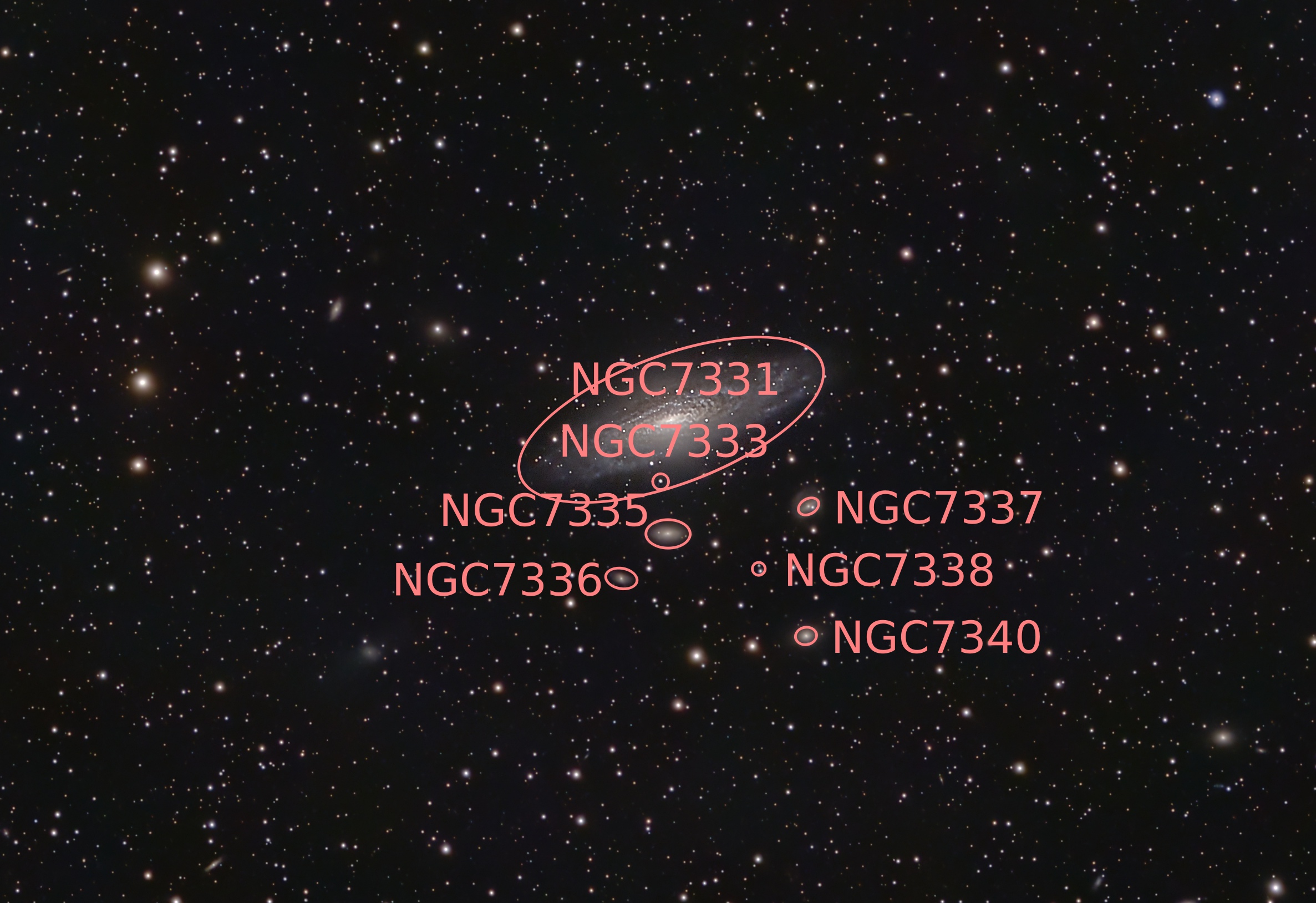
NGC 7331 Galaxy

NGC 7331 Galaxy

Imaging Details
Click to Return to Home Page