NGC 7380
Common Name: Wizard Nebula
Also Known as: Sharpless 2-142 (Sh2-142)
Object Type: Open Cluster and Emission Nebula
Constellation: Cepheus
Distance from Earth: 8,500 light years
Apparent Magnitude: 7.2
Coordinates: : RA 22H 47M 21S DEC 58 deg 07 min 54 sec
Actual Size: 40,000 light years in diameter.
Apparent Dimensions: 25 arc-minutes
Discovered by: NGC 7380 was discovered by Caroline Herschel in 1787.
German-born astronomer William Herschel included his sister's discovery in his catalog, and labelled it H VIII.77.
Description: NGC 7380 is a young open cluster of stars in the northern circumpolar constellation of Cepheus.
The surrounding emission nebulosity is known colloquially as the Wizard Nebula, which spans an angle of 25′.
The combination of interstellar gas and dust in this deep sky object has created a shape that resembles a sorcerer, or, wizard.
The nebula is known as S 142 in the 1959 Sharpless catalog (Sh2-142).
The NGC 7380 complex is located in the Perseus Arm of the Milky Way.
The cluster spans ~20 light-years (6 pc) with an elongated shape and an extended tail.
Age estimates range from 4 to 11.9 million years.
At the center of the cluster lies DH Cephei, a close, double-lined spectroscopic binary system consisting of two massive O-type stars.
This pair are the primary ionizing source for the surrounding H II region, and are driving out the surrounding gas and dust while triggering star formation in the neighboring region.
Of the variable stars that have been identified in the cluster, 14 have been identified as pre-main sequence stars while 17 are main sequence stars that are primarily B-type variables.
The Wizard Nebula is a collection of interstellar gas surrounding the young open star cluster, NGC 7380.
This is an active star-forming region, and the stars in NGC 7380 unleash powerful streams of charged particles known as stellar winds that have sculpted the nebula into the wizard shape we see today.
Click Below Image(s) for Full Size:
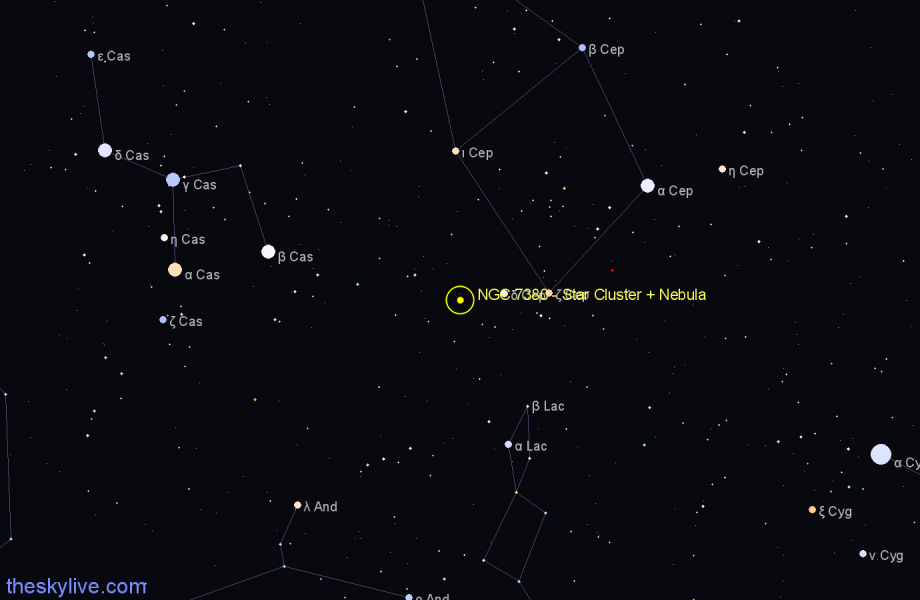
NGC 7380 is situated north of the celestial equator and, as such, it is more easily visible from the northern hemisphere.
NGC 7380 is extremely difficult to observe visually, usually requiring very dark skies and an O-III filter.
NGC 7380 is best seen in the fall months.
Platesolve
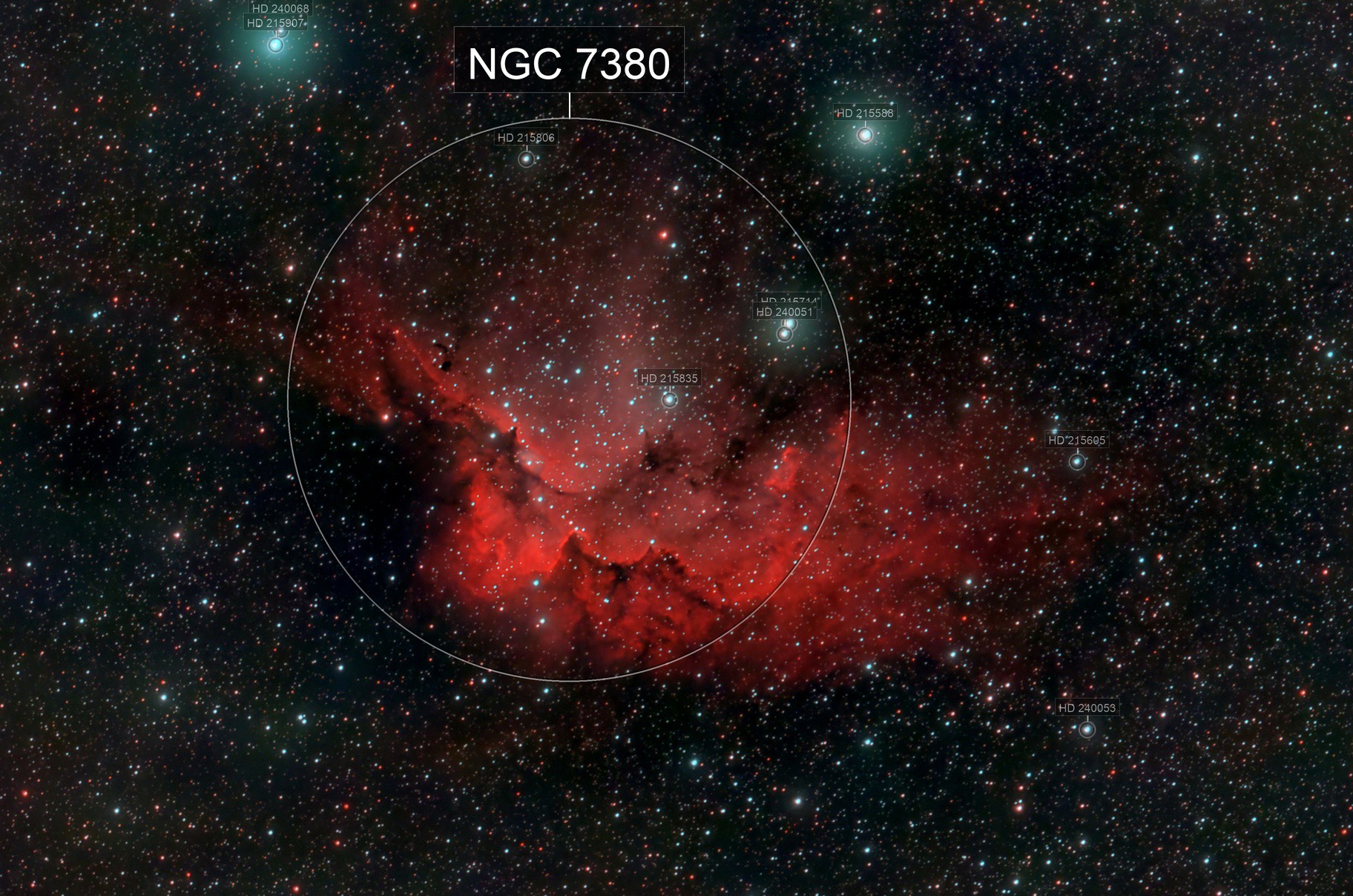
NGC 7380 Nebula

Imaging Details
Click to Return to Home Page