NGC 7635
Common Name: Bubble Nebula
Also Known as: Sharpless 162 (Sh2-162), Caldwell 11
Object Type: Emission Nebula
Constellation: Cassiopeia
Distance from Earth: 7,100 light years
Apparent Magnitude: 10.0
Coordinates: RA 22H 20M 48.3S DEC 61 deg 12 min 06 sec
Actual Size: 7 light years in diameter.
Apparent Dimensions: 15 arc-minutes x 8 arc-minutes
Discovered by: NGC 7635 was discovered in November 1787 by William Herschel.
Description: NGC 7635 is an H II region emission nebula.
The "bubble" is created by the stellar wind from a massive hot, 8.7 magnitude young central star.
The central star is an extremely bright, massive, and short-lived star that has lost most of its outer hydrogen and is now fusing helium into heavier elements. The star is about 4 million years old, and in 10 million to 20 million years, it will likely detonate as a supernova.
The nebula is near a giant molecular cloud which contains the expansion of the bubble nebula while itself being excited by the hot central star, causing it to glow.
The seething star forming this nebula is 45 times more massive than our sun.
Gas on the star gets so hot that it escapes away into space as a "stellar wind" moving at over 4 million miles per hour.
This outflow sweeps up the cold, interstellar gas in front of it, forming the outer edge of the bubble much like a snowplow piles up snow in front of it as it moves forward.
The gases heated to varying temperatures emit different colors: oxygen is hot enough to emit blue light in the bubble near the star,
while the cooler pillars are yellow from the combined light of hydrogen and nitrogen.
Click Below Image(s) for Full Size:
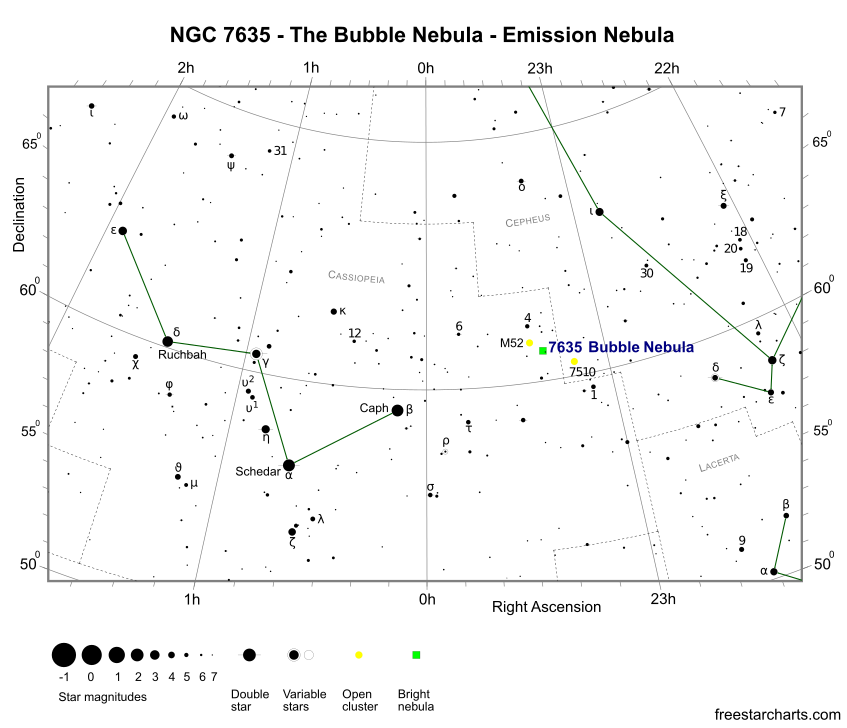
With an 8-or-10-inch (200 or 250 mm) telescope, the nebula is visible as an extremely faint and large shell around the star.
The nearby 7th magnitude star on the west hinders observation, but one can view the nebula using averted vision.
Using a 16-to-18-inch (410 to 460 mm) scope, one can see that the faint nebula is irregular, being elongated in the north south direction.
The Bubble Nebula resides in the northern constellation Cassiopeia. For amateur astrophotographers at mid-northern latitudes, the best time to photograph the Bubble Nebula is in the fall.
Platesolve
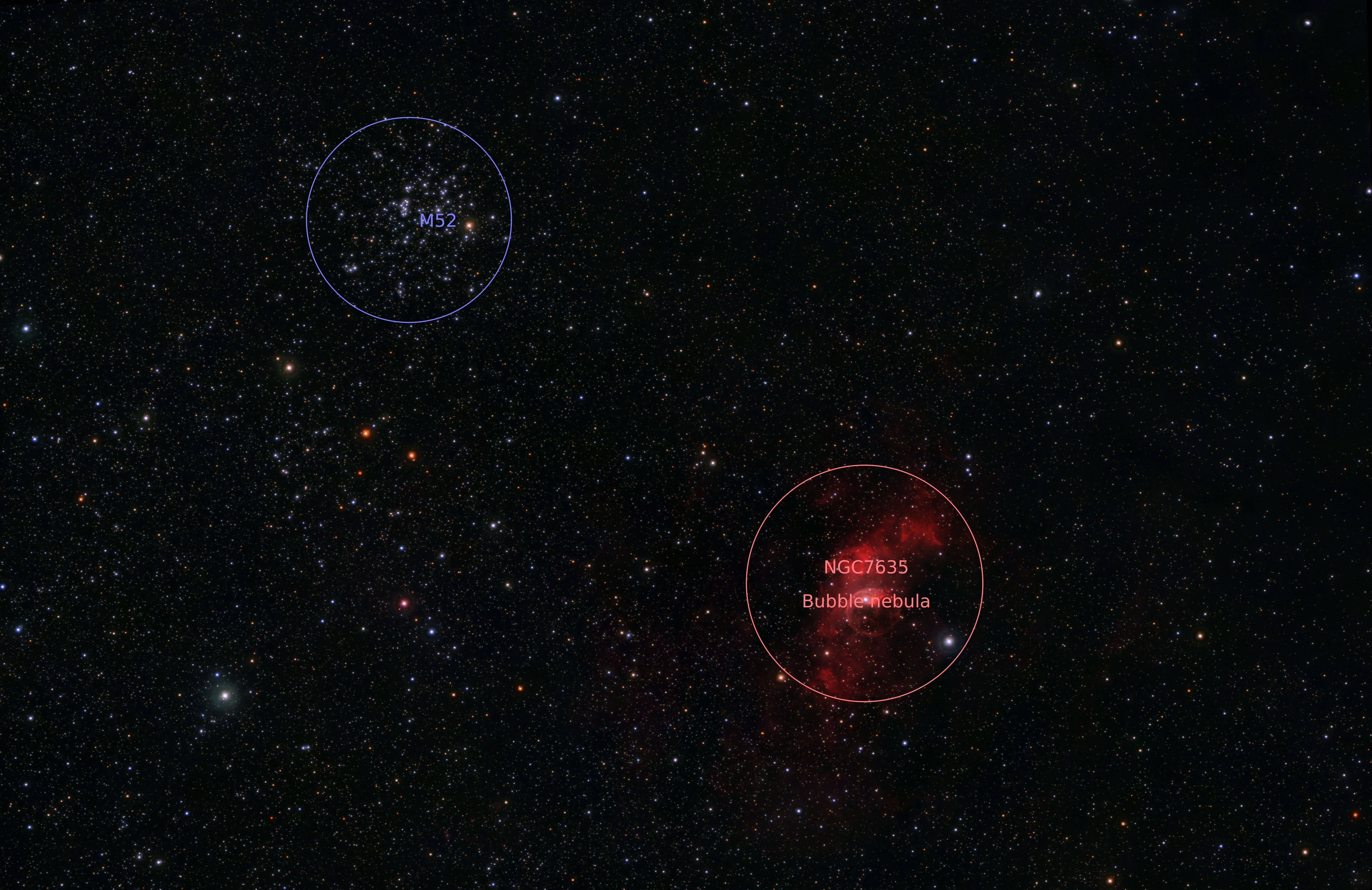
NGC 7635 Nebula

Imaging Details
Click to Return to Home Page