Sharpless 101 (Sh2-101)
Common Name: Tulip Nebula
Also Known as: Cygnus star cloud
Object Type: Hii region Emission Nebula
Constellation: Cygnus
Distance from Earth: 6,000 Light years
Apparent Magnitude: 9.0
Coordinates: RA 20H 00M 29.37S DEC 35 deg 19 min 13.9 sec
Actual Size: 28 light years
Apparent Dimensions: 16 arc-minutes x 9 arc-minutes
Discovered by:
Description: Sharpless 101 is a H II region emission nebula located in the constellation Cygnus.
It is sometimes also called the Tulip Nebula because it appears to resemble the outline of a tulip when imaged photographically.
It was catalogued by astronomer Stewart Sharpless in his 1959 catalog of nebulae. It lies at a distance of about 6,000 light-years from Earth.
Sharpless 101 gets its glow from the hot young star HD 227018 visible within the Tulip.
Sh2-101 is a popular astrophotography target not only because of the amount of gas all around, but because it is very close to Cygnus X-1,
a micro-quasar and galactic X-ray source that was most likely the first black hole every discovered from such a source.
In photographs, the bow shockwave of extremely hot gas seems to escape from the center of the Tulip.
Sh2-101, at least in the field seen from Earth, is in close proximity to microquasar Cygnus X-1, site of one of the first suspected black holes.
Cygnus X-1 is located about 15′ west of Sh2-101. The companion star of Cygnus X-1 is a spectral class O9.7 Iab supergiant with a mass of 21 solar masses and 20 times the radius of the Sun. The period of the binary system is 5.8 days and the pair is separated by 0.2 astronomical units.
The black hole has a mass of 15 solar masses and a Schwarzschild radius of 45 km.
A bowshock is created by a jet of energetic particles from the black hole as they interact with the interstellar medium.
Click Below Image(s) for Full Size:
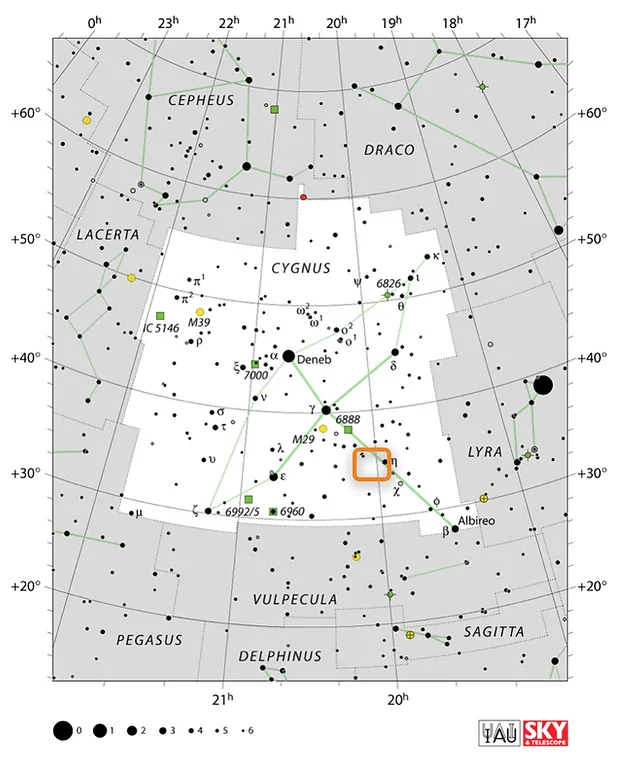
The Tulip Nebula is located in the busy constellation of the swan: Cygnus.
It is close to other popular objects, like the Crescent Nebula (NGC 6888), the Veil Nebula complex, the North America Nebula (NGC 7000), and the beautiful open cluster Messier 29.
To find the Tulip Nebula, look for one of the brightest stars in the Summer sky: Deneb. This star represents the tail of the swan.
From there, star hope to the center star in Cygnus, very close to where NGC 6888 is located. Now slowly make your way up the long neck of the bird.
The Tulip lies about halfway between the center star and the head of the swan.
Sharpless 101 Nebula

Imaging Details
Click to Return to Home Page