Solar Eclipse 2017
Solar Eclipse Background: A solar eclipse occurs when the Moon passes between Earth and the Sun, thereby obscuring the view of the Sun from a small part of the Earth, totally or partially.
Such an alignment occurs approximately every six months, during the eclipse season in its new moon phase, when the Moon's orbital plane is closest to the plane of the Earth's orbit. In a total eclipse,
the disk of the Sun is fully obscured by the Moon.
In partial and annular eclipses, only part of the Sun is obscured. Unlike a lunar eclipse, which may be viewed from anywhere on the night side of Earth,
a solar eclipse can only be viewed from a relatively small area of the world.
As such, although total solar eclipses occur somewhere on Earth every 18 months on average, they recur at any given place only once every 360 to 410 years.
If the Moon were in a perfectly circular orbit and in the same orbital plane as Earth, there would be total solar eclipses once a month, at every new moon.
Instead, because the Moon's orbit is tilted at about 5 degrees to Earth's orbit, its shadow usually misses Earth. Solar (and lunar) eclipses therefore happen only during eclipse seasons, resulting in at least two,
and up to five, solar eclipses each year, no more than two of which can be total.
Total eclipses are more rare because they require a more precise alignment between the centers of the Sun and Moon, and because the Moon's apparent size in the sky is sometimes too small to fully cover the Sun.
An eclipse is a natural phenomenon.
In some ancient and modern cultures, solar eclipses were attributed to supernatural causes or regarded as bad omens.
Astronomers' predictions of eclipses began in China as early as the 4th century BC; eclipses hundreds of years into the future may now be predicted with high accuracy.
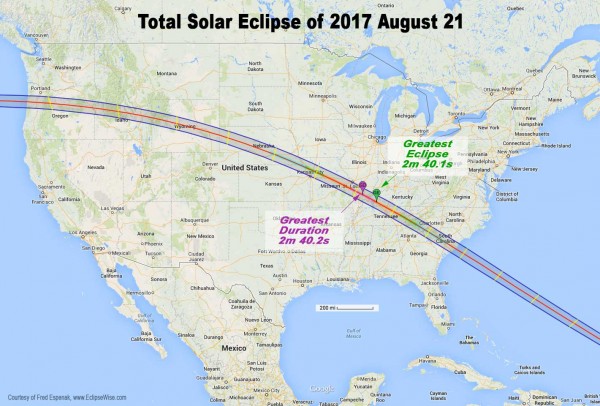
Description: The solar eclipse of August 21, 2017, dubbed the "Great American Eclipse" by some media, was a total solar eclipse visible within a band that spanned the contiguous United States from the Pacific to the Atlantic coasts.
It was also visible as a partial solar eclipse from as far north as Nunavut in northern Canada to as far south as northern South America.
In northwestern Europe and Africa, it was partially visible in the late evening. In northeastern Asia, it was partially visible at sunrise.
The total eclipse had a magnitude of 1.0306 and was visible within a narrow corridor 70 miles (110 km) wide,
crossing 14 of the contiguous United States: Oregon, Idaho, Montana, Wyoming, Nebraska, Kansas, Iowa, Missouri, Illinois, Kentucky, Tennessee, Georgia, North Carolina, and South Carolina. It was first seen from land in the U.S.
shortly after 10:15 am PDT (17:15 UTC) at Oregon's Pa
The totality track of the Solar eclipse of 2017 went from Oregon to South Carolina.
In New England, the eclipse of 2017 was a partial eclipse with about 65% coverage.
Solar Eclipse 2017 Path
Solar Eclipse Video from New England 2017
Click to Return to Home Page