Messier 77 (M77)
Common Name: Squid Galaxy
Also Known as: NGC 1068, Cetus A
Object Type: Barred Spiral Galaxy
Constellation: Cetus
Distance from Earth: 47 million light years
Apparent Magnitude: 9.6
Coordinates: RA 02H 42M 40.7S DEC 00 deg 00 min 48 sec
Actual Size: 170,000 light years in diameter
Apparent Dimensions: 7.1 arc-minutes x 6.0 arc-minutes
Discovered by: Messier 77 was discovered by the French astronomer Pierre Méchain on October 29, 1780. Méchain described the object as a nebula.
Charles Messier added M77 to his catalogue on December 17, 1780, describing it as a star cluster with some nebulosity.
He noted, “Cluster of small stars, which contains some nebulosity, in Cetus & on the parallel of the star Delta, reported of the third magnitude, which M. Messier estimated to be hardly of the fifth.
Méchain saw this cluster on October 29, 1780 in the form of a nebula.”
Description: M77 is one of the largest galaxies listed in the Messier catalog. M77 is an active galaxy.
It is classified as a type 2 Seyfert galaxy and is the brightest galaxy of this type in the sky.
Named after the American astronomer Carl Seyfert, who was the first to identify the class in 1943, Seyfert galaxies are characterized by hot, highly ionized gas around an extremely active center.
M77 serves as the prototype for the class. The galaxy’ active galactic nucleus (AGN) is hidden from view by dust and cannot be seen in visible light.
Messier 77 is also the nearest Seyfert galaxy to the solar system, and one of the most studied galaxies in the sky.
Classified as a barred spiral, M77 has loosely wound spiral arms, dotted with countless star forming regions, and a small central bulge.
The supermassive black hole at the galaxy’s core has an estimated mass of around 15 million times that of the Sun and is less than 12 light years in diameter.
The galaxy itself has a mass of about 1 billion solar masses.
It contains >300 billion stars.
Messier 77 is the central member of the M77 Group, a small group of physically related galaxies which also includes the galaxies NGC 1055, NGC 1073, UGC 2161, UGC 2275, UGC 2302, UGCA 44, and Markarian 600.
Several other galaxies (NGC 1087, NGC 1090, NGC 1094) can be seen in this region of the sky, but they lie in the background.
M77 is moving away at a rate of 1,137 km/s.
Click Below Image(s) for Full Size:
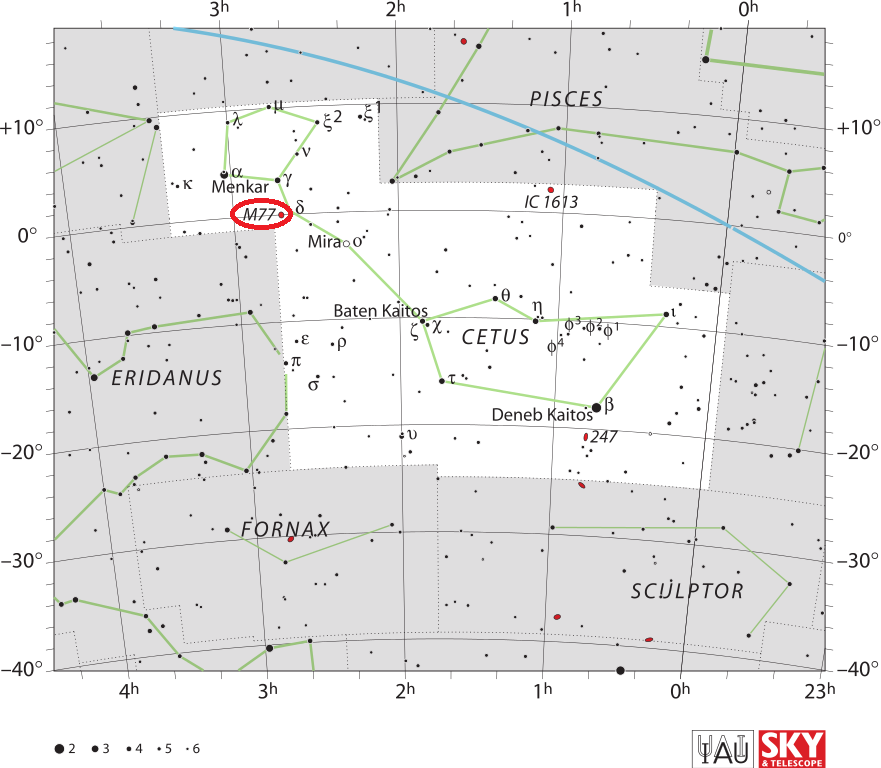
The galaxy is easy to spot with binoculars as it is quite compact and has a bright core.
Small telescopes reveal a fuzzy ball of light with a bright center. A 4 inch telescope will reveal the galaxy’s oval halo.
In order to see the details of the galaxy’s structure at least an 8 inch scope is required.
The best time to observe M77 is in the autumn.
Platesolve
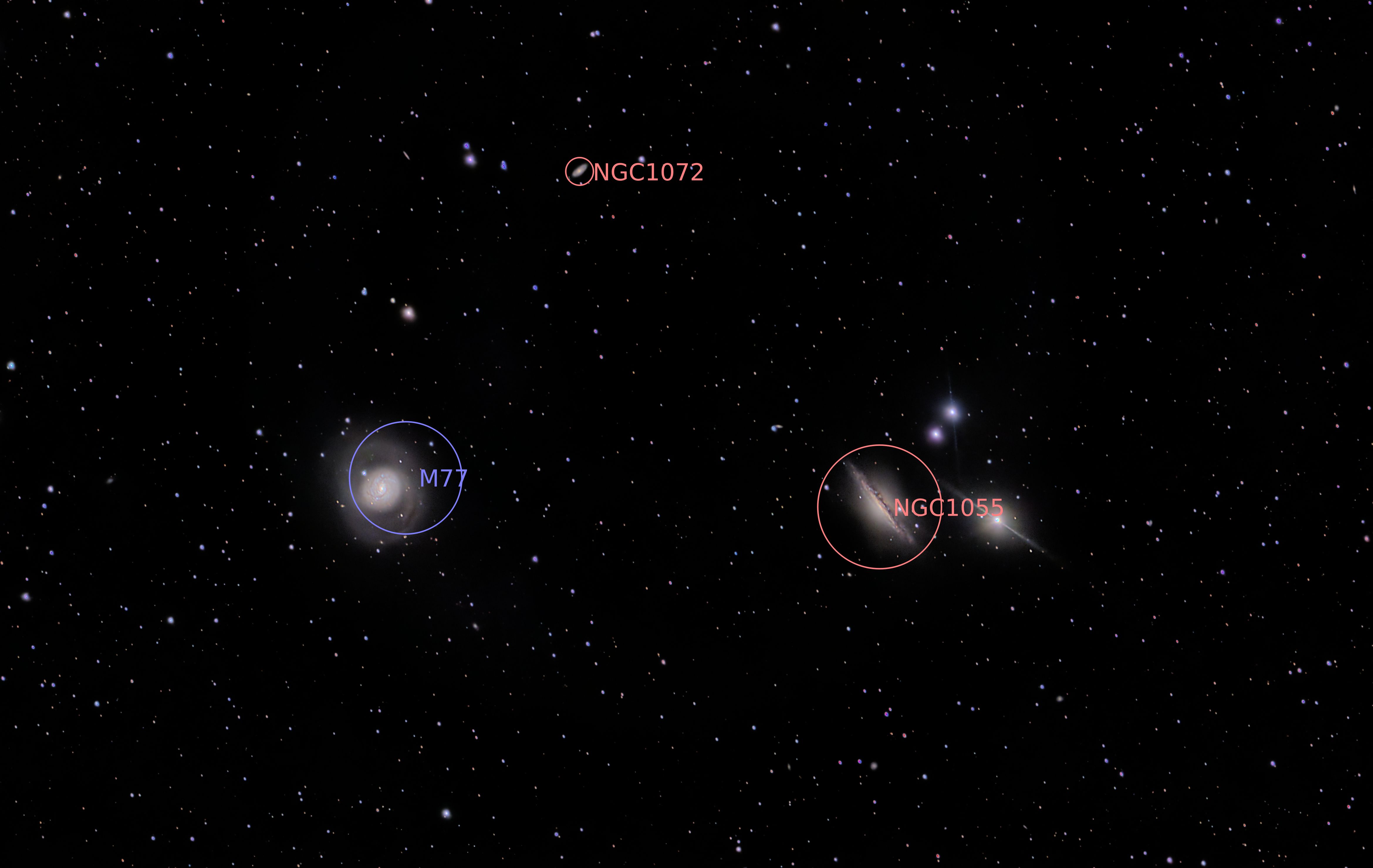
M77 Spiral Galaxy

Imaging Details
Click to Return to Home Page