NGC 185
Also Known as: Caldwell 18
Object Type: Dwarf Spheroidal Galaxy
Constellation: Cassiopeia
Distance from Earth: 2.05 million light years
Apparent Magnitude: 9.2
Coordinates: RA 00H 38M 57.97S DEC 48deg 20min 14.56sec
Actual Size: 10,000 light years in diameter
Apparent Dimensions: 11.7 arc-minutes x 10.9 arc-minutes
Discovered by: NGC 185 was discovered by William Herschel on November 30, 1787, and he cataloged it "H II.707". John Herschel observed the object again in 1833 when he cataloged it as "h 35", and then in 1864 when he cataloged it as "GC 90" within his General Catalogue of Nebulae and Clusters.
Description: NGC 185 is a member of the Local Group, and is a satellite of the Andromeda Galaxy (M31).
Unlike most dwarf elliptical galaxies, NGC 185 contains young stellar clusters, and star formation proceeded at a low rate until the recent past.
NGC 185 has an active galactic nucleus (AGN) and is usually classified as a type 2 Seyfert galaxy, though its status as a Seyfert is questioned.
It is possibly the closest Seyfert galaxy to Earth, and is the only known Seyfert in the Local Group.
Click Below Image(s) for Full Size:
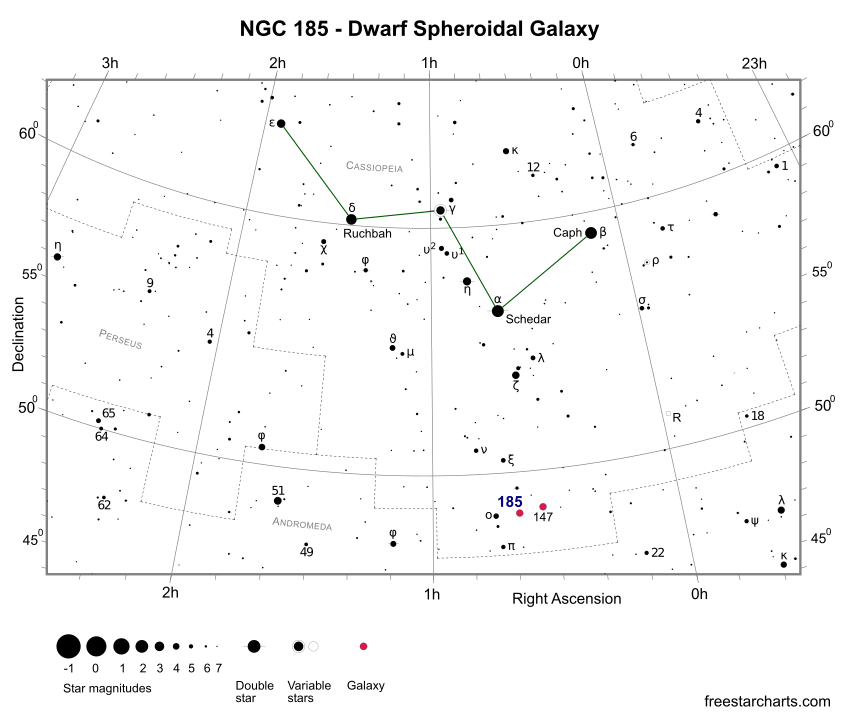
NGC 185 galaxy can be found with powerful binoculars. It is easier to spot than the neighboring Caldwell 17, because its center appears more circular and compact than that of its neighbor.
Best observing time is in the months July through January, when this circumpolar constellation is highest in the sky.
Platesolve
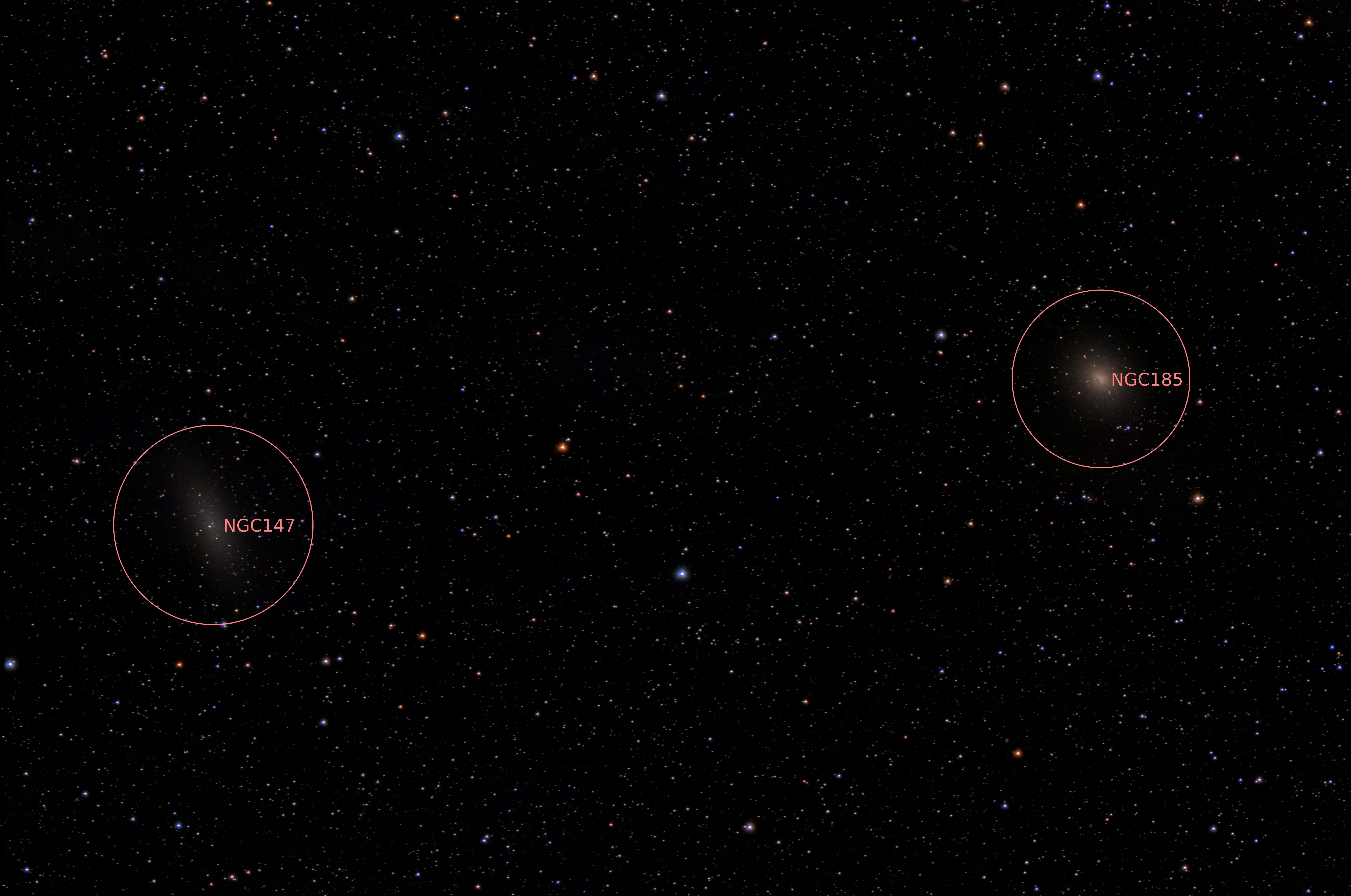
NGC 185 Galaxy
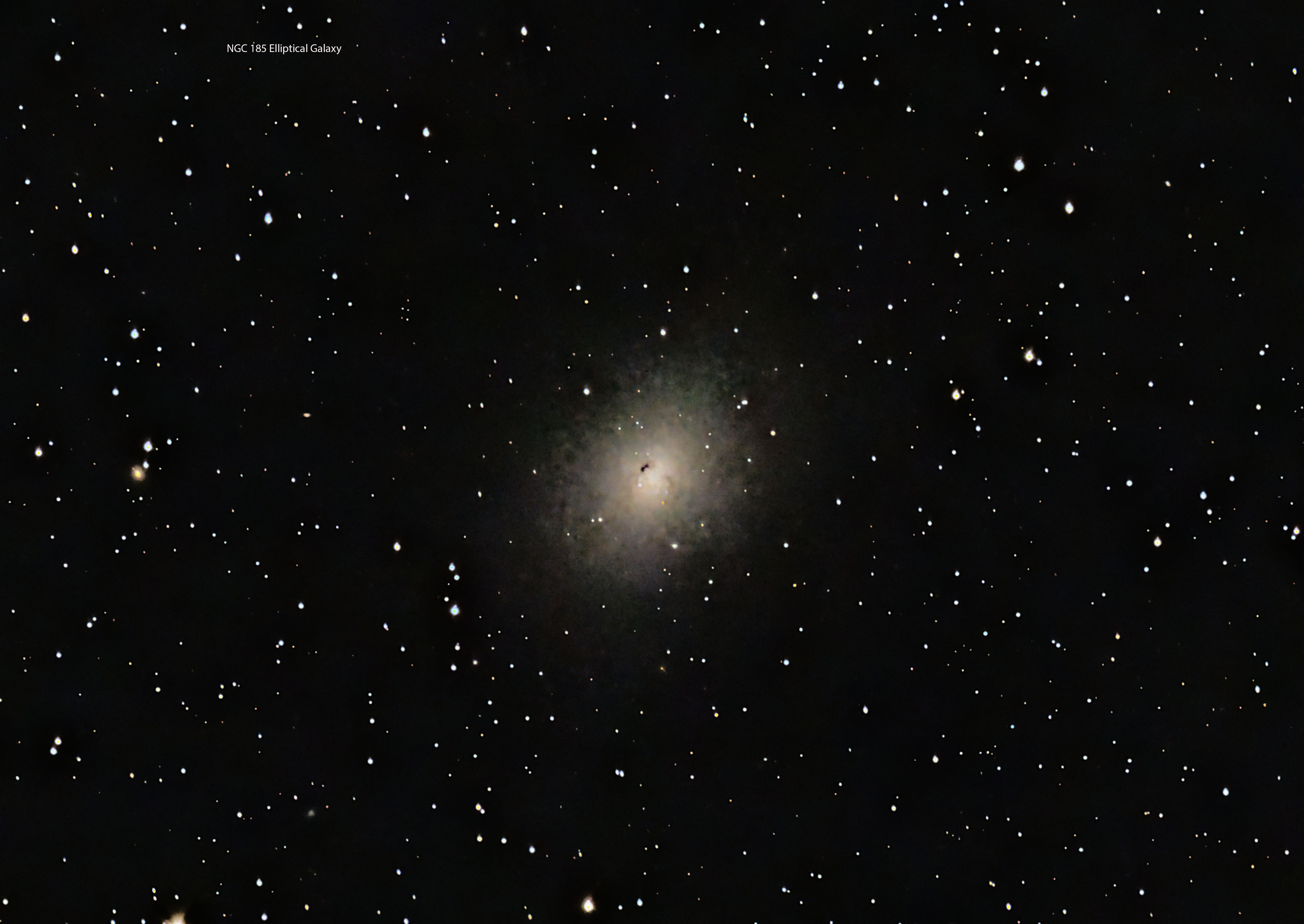
NGC 185 and NGC 147 Wide View

Imaging Details
Click to Return to Home Page