NGC 6853
Common Name: Dumbbell Nebula
Also Known as: Messier 27 (M27), Apple Core Nebula, Diabolo Nebula
Object Type: Planetary Nebula
Constellation: Vulpecula
Distance from Earth: 1,360 light years
Apparent Magnitude: 7.5
Coordinates: RA 19H 59M 36.34S DEC 22 deg 43 min 16.09 sec
Actual Size: 2.88 light years in diameter.
Apparent Dimensions: 8 arc-minutes x 5.6 arc-minutes
Discovered by: Messier 27 was the first ever planetary nebula to be discovered.
Charles Messier found it on July 12, 1764 and described it as a “nebula without star” that “appears of oval shape.” In the first Messier catalogue (1771)
Description: Planetary nebulae are what our Sun will produce when it nears the end of its life and nuclear fusion stops in its core.
These nebulae are formed when evolved giant stars eject their outer envelopes, exposing the hot core of the star, which then ionizes the surrounding cloud of expelled material with ultraviolet light.
The clouds keep expanding until they dissipate into the surrounding space.
The central region of M27 contains dark and bright knots which vary in size and shape. Some are symmetrical and have tails while others do not.
The knots are anywhere from 17 to 56 billion kilometers (11 to 35 billion miles) in size and each of them has a mass three times that of our planet.
M27 is large and bright making it a popular object for amateur astronomers. It covers an area of 8 x 5.6 arc-minutes although it’s faint halo stretches out to 15 arc-minutes.
Messier 27 is the second brightest planetary nebula in the sky, second only to the Helix Nebula in Aquarius, and probably the easiest one to observe because it has a higher surface brightness than the Helix and is therefore easier to find.
The Dumbbell Nebula is more than 100 times more luminous than our Sun, while the central star has only about a third of the Sun’s luminosity and the companion is almost 100 times fainter.
The nebula is brighter than the star itself because the star mainly emits in the non-visible part of the spectrum and then the nebula absorbs the radiation and emits much of it in visible light.
The bright central section is expanding at a rate of 6.8 arc seconds per century, which gives the nebula an estimated age of 3,000 to 4,000 years.
In 1970, a group of researchers calculated an expansion velocity of 31 km/s, which would put the nebula’s kinetic age at 9,800 years.
The name Dumbbell comes from John Herschel who observed it in 1828 and compared its shape to a dumbbell. Visually the nebula appears white even in large telescopes.
The estimated age of M27 is under 14,600 years and it is expanding at a rate of 2.3 arc-seconds per century. The central star is a white dwarf with a visual magnitude of 13.5 making it the largest known white dwarf.
M27 has an estimated mass of 0.56 solar masses. The Dumbbell Nebula (M27) and the Little Dumbbell Nebula (M76) are two of only four planetary nebulae listed in Messier’s catalogue.
The remaining two are the famous Ring Nebula (M57) in the constellation Lyra and the Owl Nebula (M97) in Ursa Major.
Click Below Image(s) for Full Size:
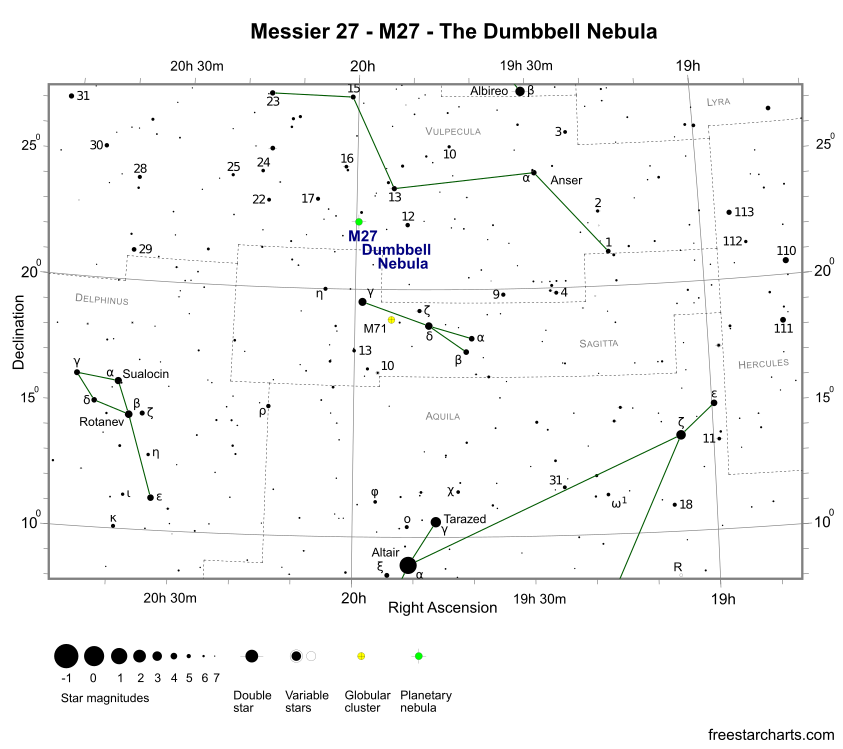
The Dumbbell Nebula is large in size and quite bright, which makes it a popular object among amateur astronomers. It can be seen in binoculars and small telescopes.
The best time to see M27 is in late autumn to early spring. The constellation Orion, which contains the Orion Nebula, is highest in the sky around midnight in mid-December.
Platesolve
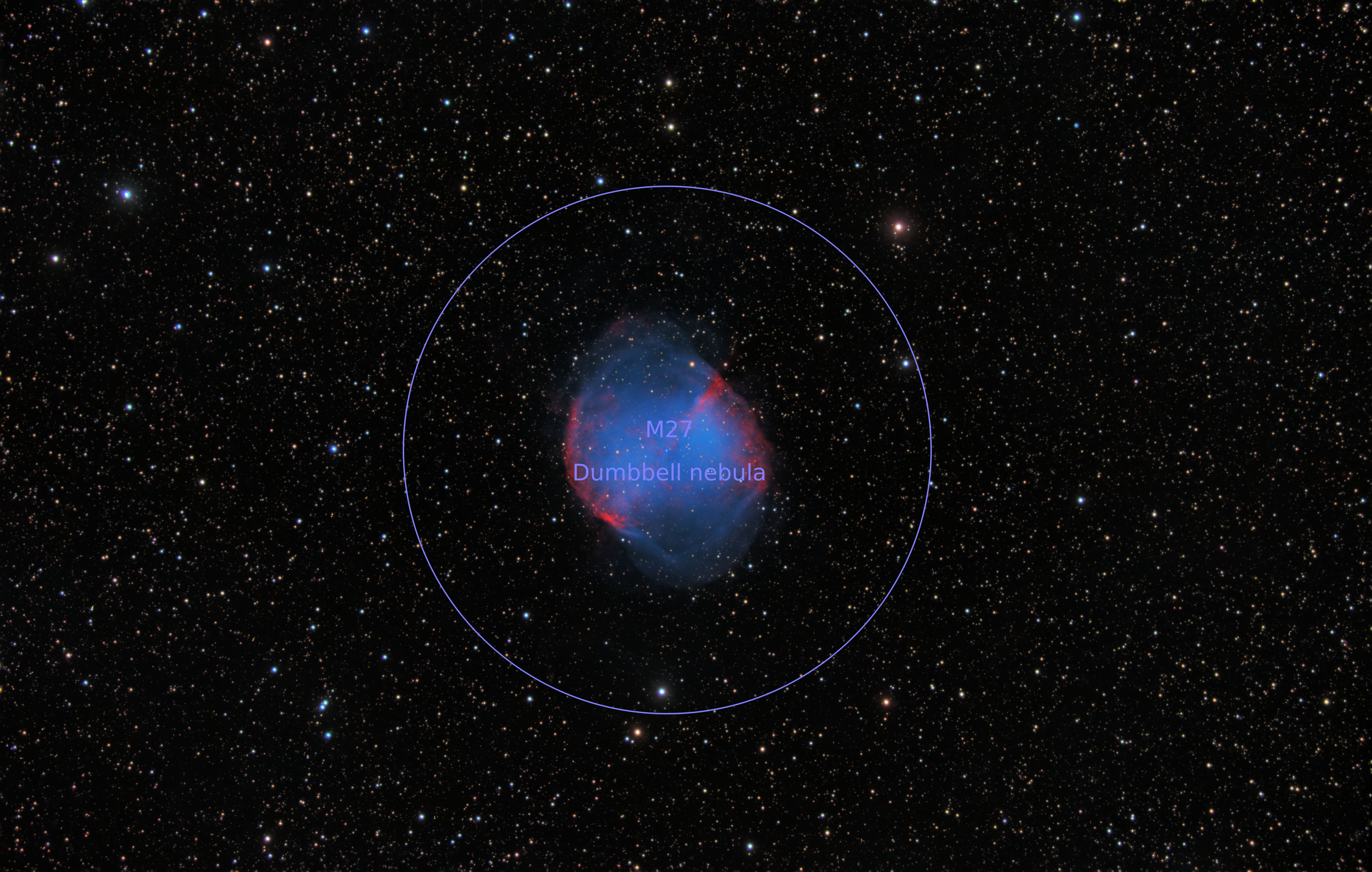
NGC 6853 Planetary Nebula

Imaging Details
Click to Return to Home Page