NGC 7354
Also Known as: PN G107.8+02.3 IRAS 22384+6101
Object Type: Planetary Nebula
Constellation: Cepheus
Distance from Earth: 5,538 light years
Apparent Magnitude: 12.2
Coordinates: RA 22H 40M 19.87387 Sec DEC 61 deg 17 min 08.7444 sec
Actual Size: The inner ring is 0.4 light years across, the outer around 0.6 light years.
Apparent Dimensions: 23 arcseconds (0.38 arcminutes)
Discovered by: NGC 7354 was discovered on 3 November 1787 by the German-British astronomer William Herschel.
He cataloged it as «faint nebula» with entry II 705 and noted: «Pretty bright, small, irregularly round, almost equally bright.»
His son John observed the on 9 October 1829, cataloged it as h 2178 and noted: «Bright enough to be noticed and caught in sweeping in full moonlight, with the moon on meridian, pretty gradually brighter in the middle, round, no nucleus seen.»
In his «General Catalogue» published 1864 the nebula is listed with the designation GC 4827.
Lord Rosse (or more likely one of his assistants) suspected the nebula to be a planetary in 1861.
John L. E. Dreyer added then the nebula as NGC 7354 in his 1888 «New General Catalogue of Nebulae and Clusters.
Description:
NGC 7354 is a planetary nebula located in the northern circumpolar constellation of Cepheus.
The central star is a dim magnitude 16.2
Winds from the central star are believed to play an important role in the shape of planetary nebulae.
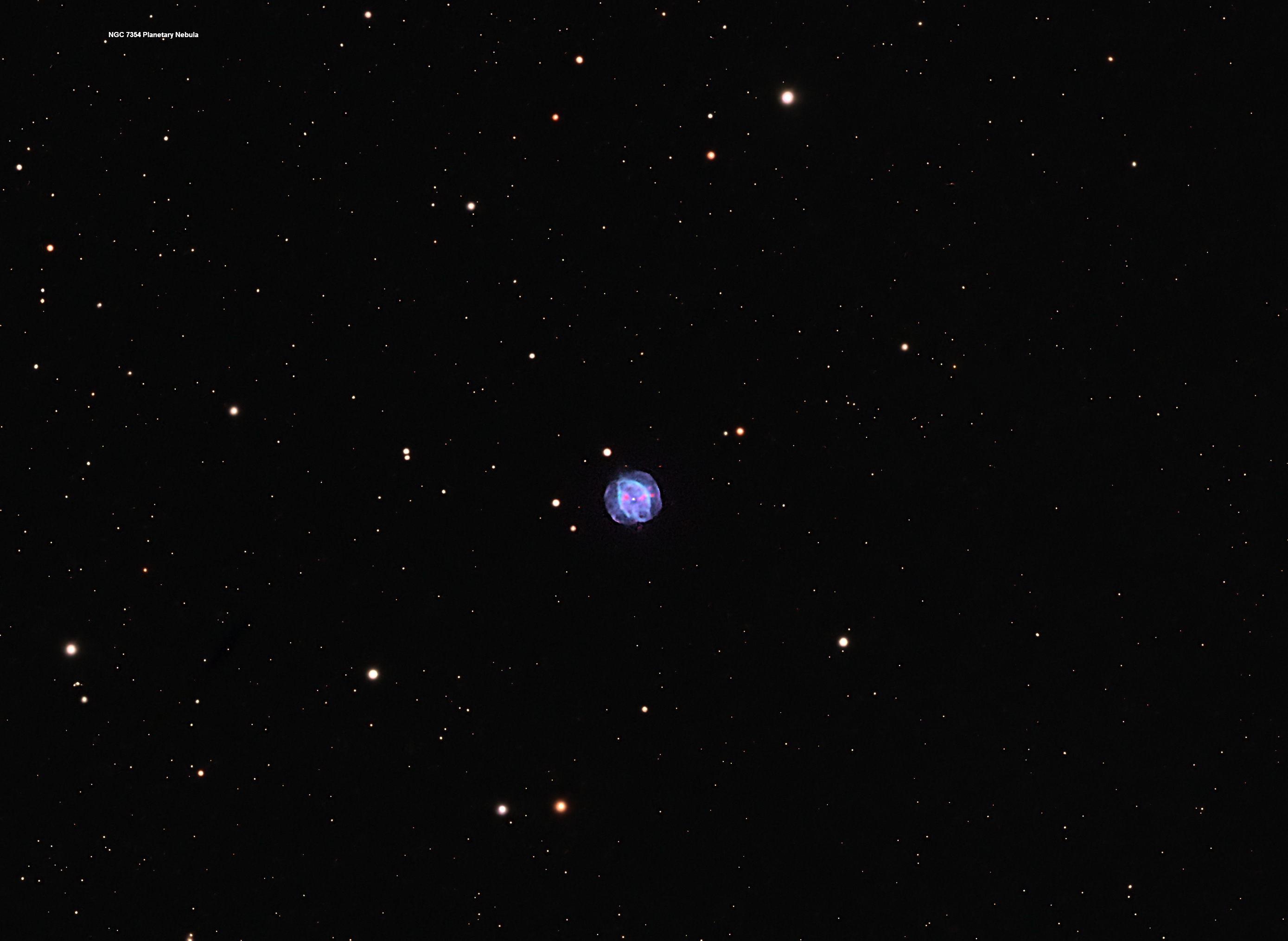
The composition of NGC 7354 is relatively easy to distinguish: the planetary nebula consists of a spherical outer envelope, an ellipsoidal inner envelope,
a collection of bright knots concentrated in the center, and two symmetrical jets shooting gas into the interstellar medium on either side.
It is believed that these properties were caused by a companion star of the central star, but its presence has not yet been confirmed.
This nebula is the result of an aging star casting off its outer atmosphere.
Overall the nebula is elliptical in form, with a complex interior structure having inner and outer shells, several bright equatorial knots, and two jet-like features near the nebula poles.
The rim of the inner shell is ellipsoidal with an aspect ratio of 1.6 and a major axis spanning 30″.
The outer shell is more circular, and is approximately 33″ in diameter.
The faint outer shell is expanding with a higher velocity than the inner shell, and the knots are moving at the same velocity as the outer shell.
The outer shell has an estimated age of 2,500 years, while the inner shell is 1,600 years old.
The morphological features of the nebula may be explained by an interacting binary star system with one of the pair passing through the asymptotic giant branch phase.
The jets may be generated by an accretion disk surrounding the resulting white dwarf star. Additionally, an analysis of Gaia data suggests that the central star is binary.
Click Below Image(s) for Full Size:
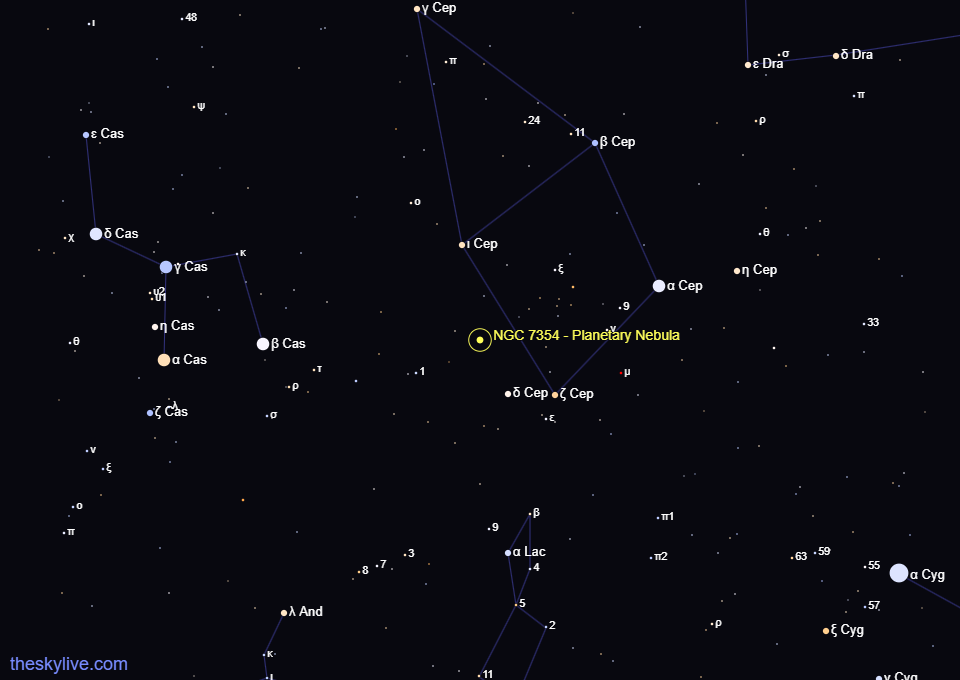
NGC 7354 is a Planetary Nebula in the Cepheus constellation. NGC 7354 is situated close to the northern celestial pole and, as such, it is visible for most part of the year from the northern hemisphere.
Given its visual magnitude, NGC 7354 is visible with the help of a telescope having an aperture of 8 inches (200mm) or more.
Platesolve
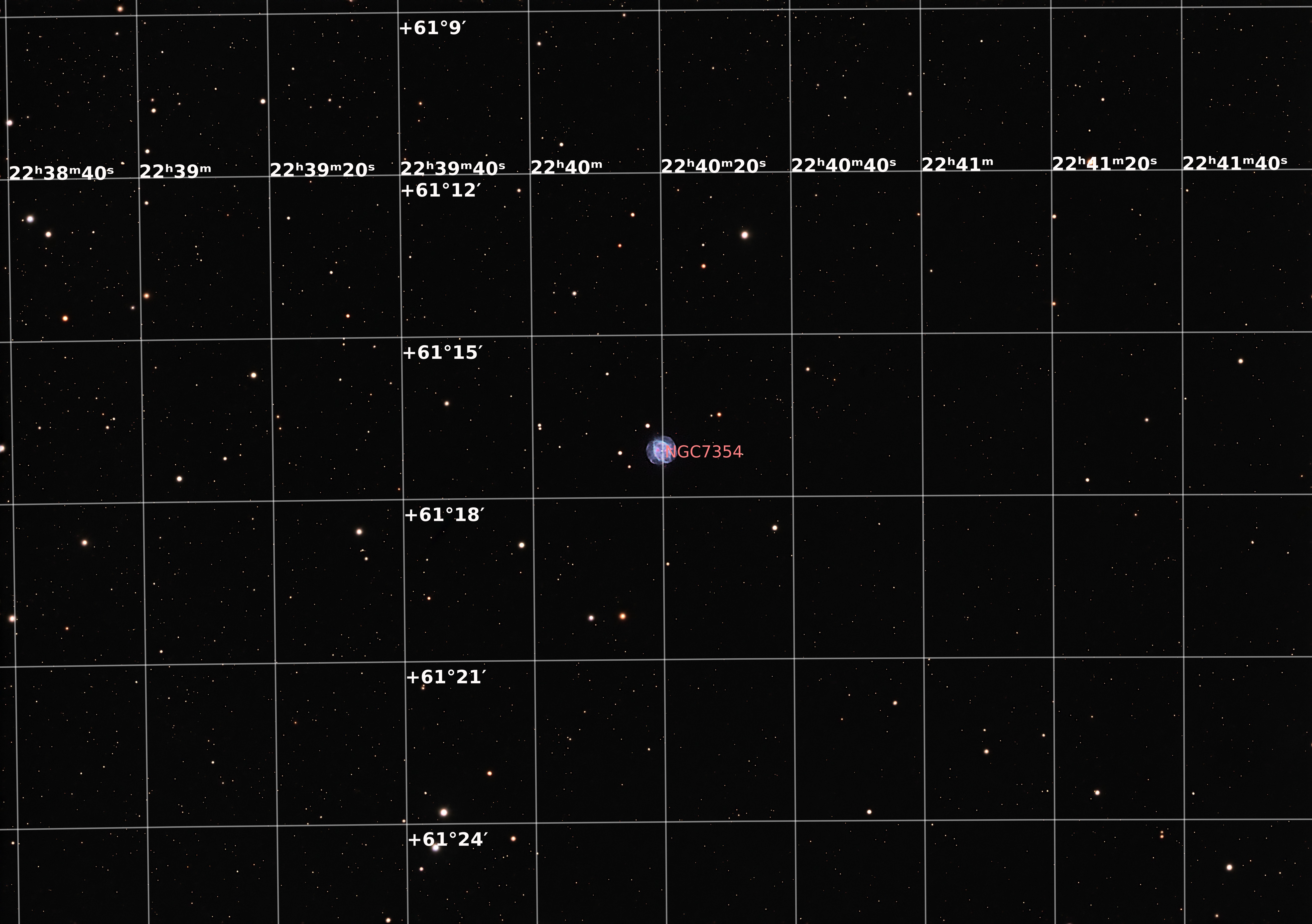
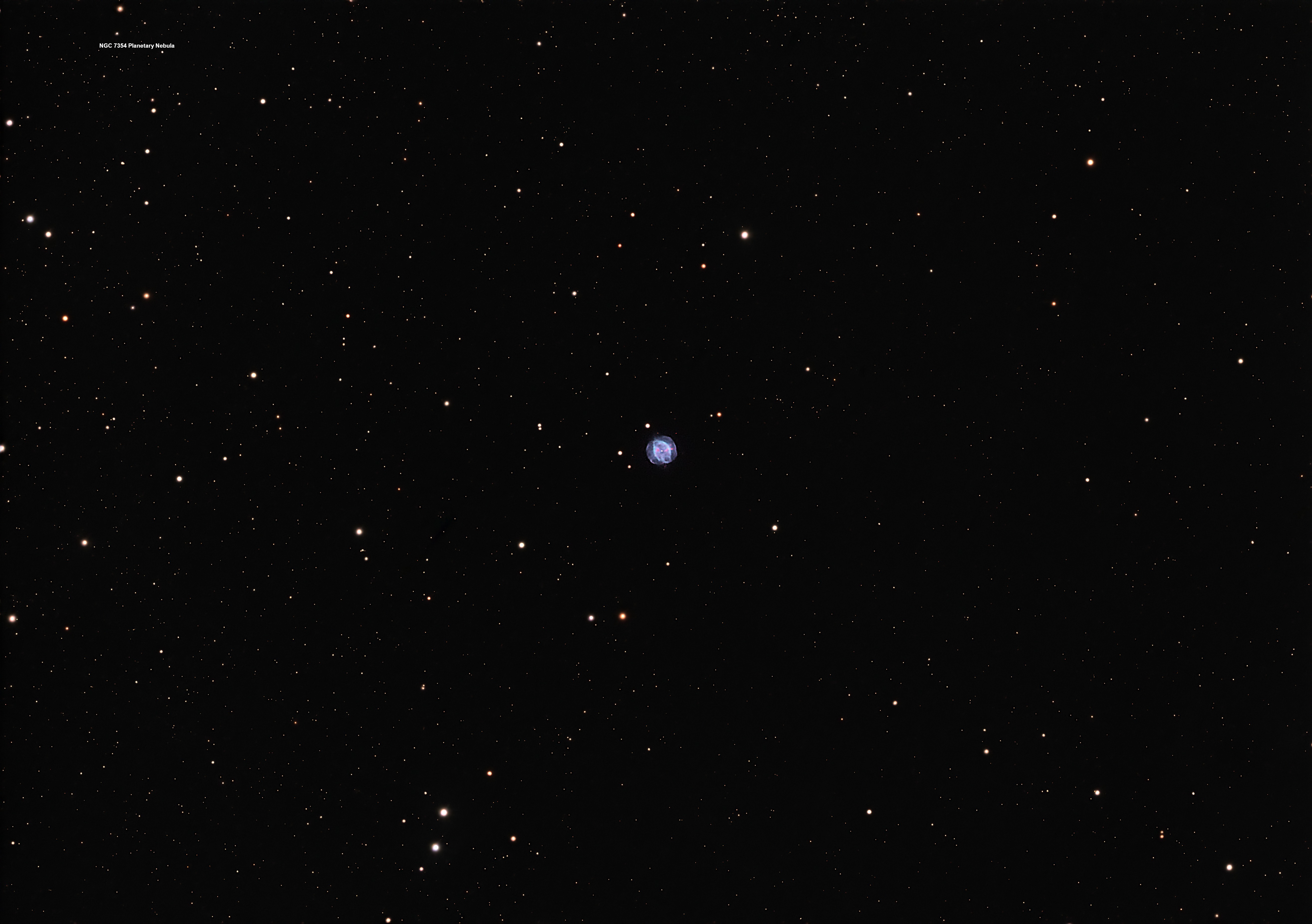
NGC 7354 Planetary Nebula
NGC 7354 Planetary Nebula (closeup)
Imaging Details
Click to Return to Home Page