NGC 7662
Common Name: Blue Snowball
Also Known as: Caldwell 22, Snowball nebula
Object Type: Planetary Nebula
Constellation: Andromeda
Distance from Earth: 5,730 light years
Apparent Magnitude: 8.6
Coordinates: RA 23H 25M 54S DEC 42 deg 32 min 06 sec
Actual Size: 1.6 light years in diameter
Apparent Dimensions: 32 arc-minutes x 28 arc-minutes
Discovered by: NGC 7662 was discovered October 6, 1784 by the German-born English astronomer William Herschel.
In the New General Catalogue it is described as a "magnificent planetary or annular nebula, very bright, pretty small in angular size, round, blue, variable nucleus".
Description: NGC 7662 is a planetary nebula.
This nebula has an elliptical shape with a triple-shell structure.
The brightest is the main shell, which spans 12″ × 18″. This is surrounded by a fainter outer shell, which has an elliptical form.
Both shells are enclosed by a faint, circular halo, some 134″ in diameter.
The two shells can be modeled as prolate spheroids, with the inner shell having the greater elongation, a major axis tilt of 50° to the line of sight, and a hull thickness of ~2.5″.
Several knots and a jet-like structure are visible, which display emission lines and low ionization. Based on the expansion rate, the estimated age of the nebula is 3,080 years.
The central star of the planetary nebula is a subdwarf O star with a spectral type of sdO.
The best fit model for this star gives an effective temperature of 100 kK, with 5,250 times the luminosity of the Sun and 60.5% of the Sun's mass. X-ray emission from the nebula is being generated by the stellar wind from this star striking previously ejected matter.
The Blue Snowball Nebula is structurally complex and is actually a doubled ringed planetary which means it consists of a bright central ring of gas surrounded by a much larger,
dimmer and hazier envelope. The other halo along with the dim central star (mag. +13) require large amateur telescopes to be seen.
Nebulae like these represent a stage in evolution that stars like our Sun undergo when they run out of fuel.
Stars are nuclear furnaces that spend most of their lives fusing hydrogen into helium.
Massive stars have fiery fates, exploding as supernovae, but medium-mass stars like the Sun swell to become red giants as they exhaust their fuel.
The process begins when, after billions of years of nuclear fusion, the star starts to shut down. Gravity (no longer balanced by the outward pressure created by nuclear fusion) compresses the stellar core.
The star’s outer layers of gas puff away into space, creating a planetary nebula (so named because these objects often resemble planetary orbs when viewed through a small telescope).
At the center lie the remains of the original star’s compressed core, a small white dwarf.
Click Below Image(s) for Full Size:
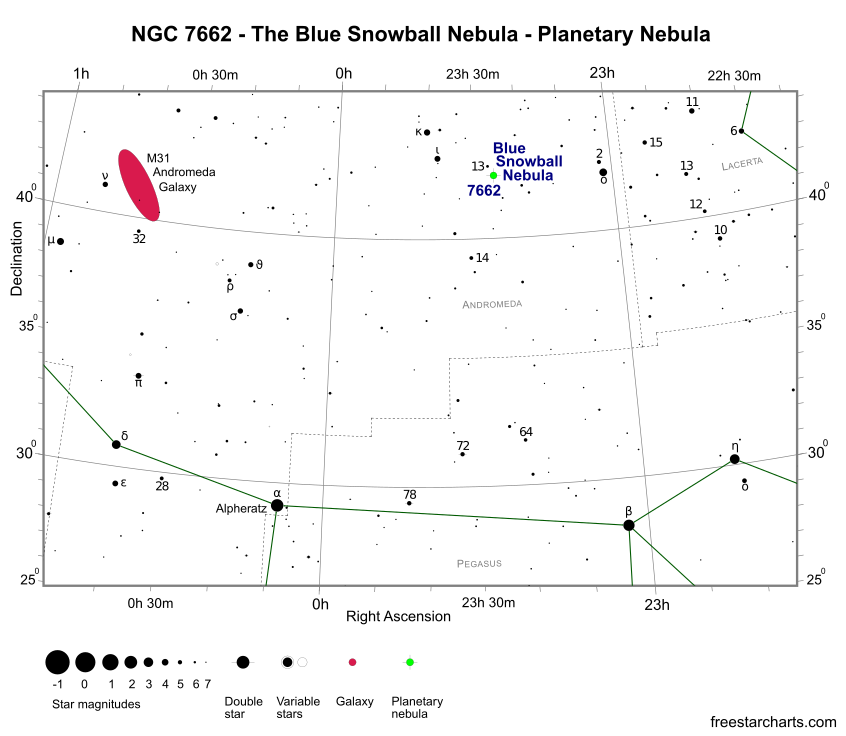
NGC 7662 is a popular planetary nebula for casual observers. A small telescope will reveal a star-like object with slight nebulosity.
A 6" telescope with a magnification around 100x will reveal a slightly bluish disk.
A 200mm (8-inch) size scope or greater at a magnification of at least 250x is recommended to show the dark center of NGC 7662.
NGC 7662 is visible with binoculars appearing star-like.
The non-stellar nature of the object is clearly visible. However, even on nights of good seeing it appears no more than an out of focus fuzzy green star.
It is best seen from Northern Hemisphere latitudes and appears high in the sky during the months of October, November and December.
Platesolve
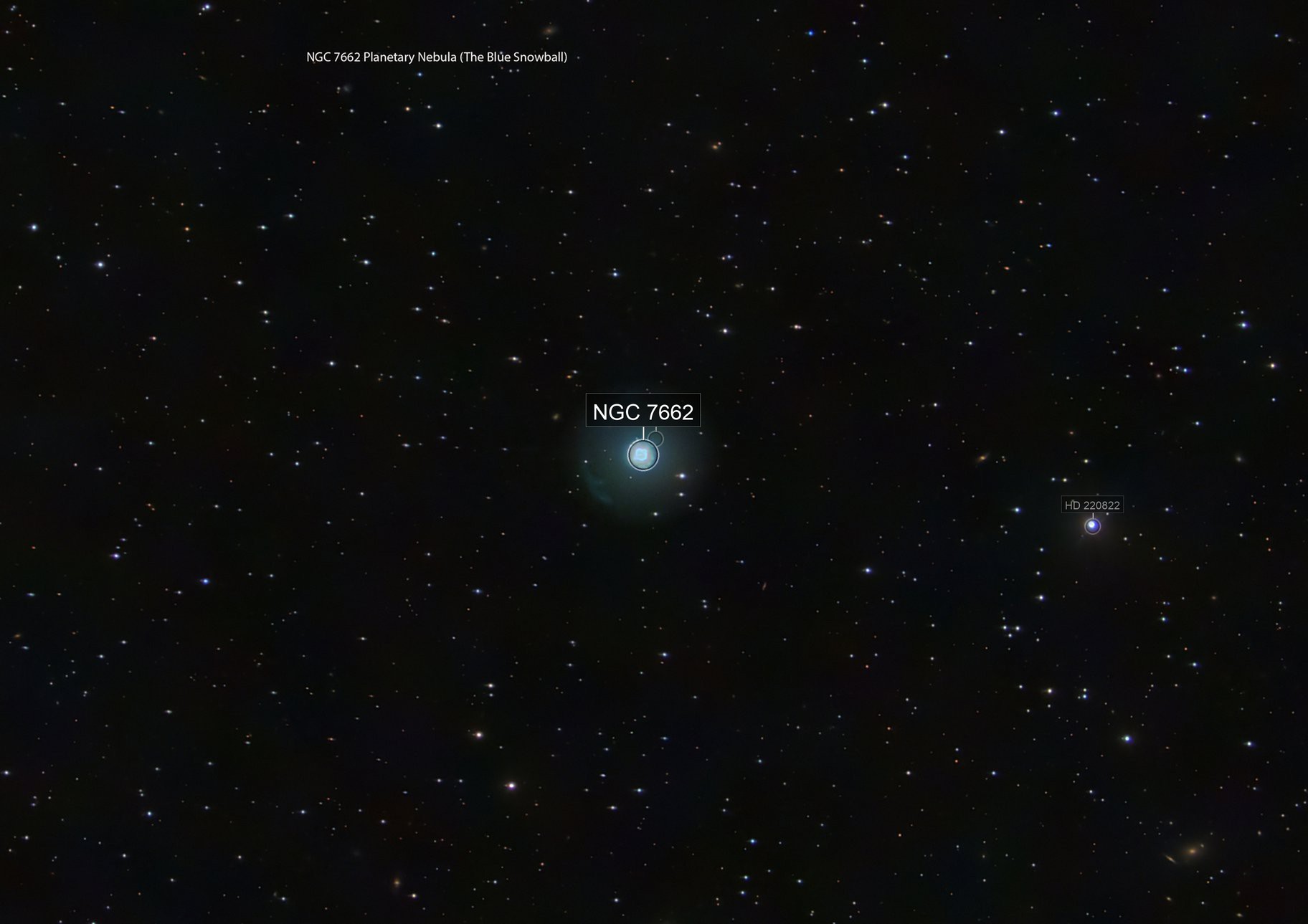
NGC 7662 Planetary Nebula

Imaging Details
Click to Return to Home Page